Compact Indoor Cannabis Grow Guide
A compact indoor cannabis grow guide for beginners who want clean setup, readable plant signals, and better flower quality in small spaces.
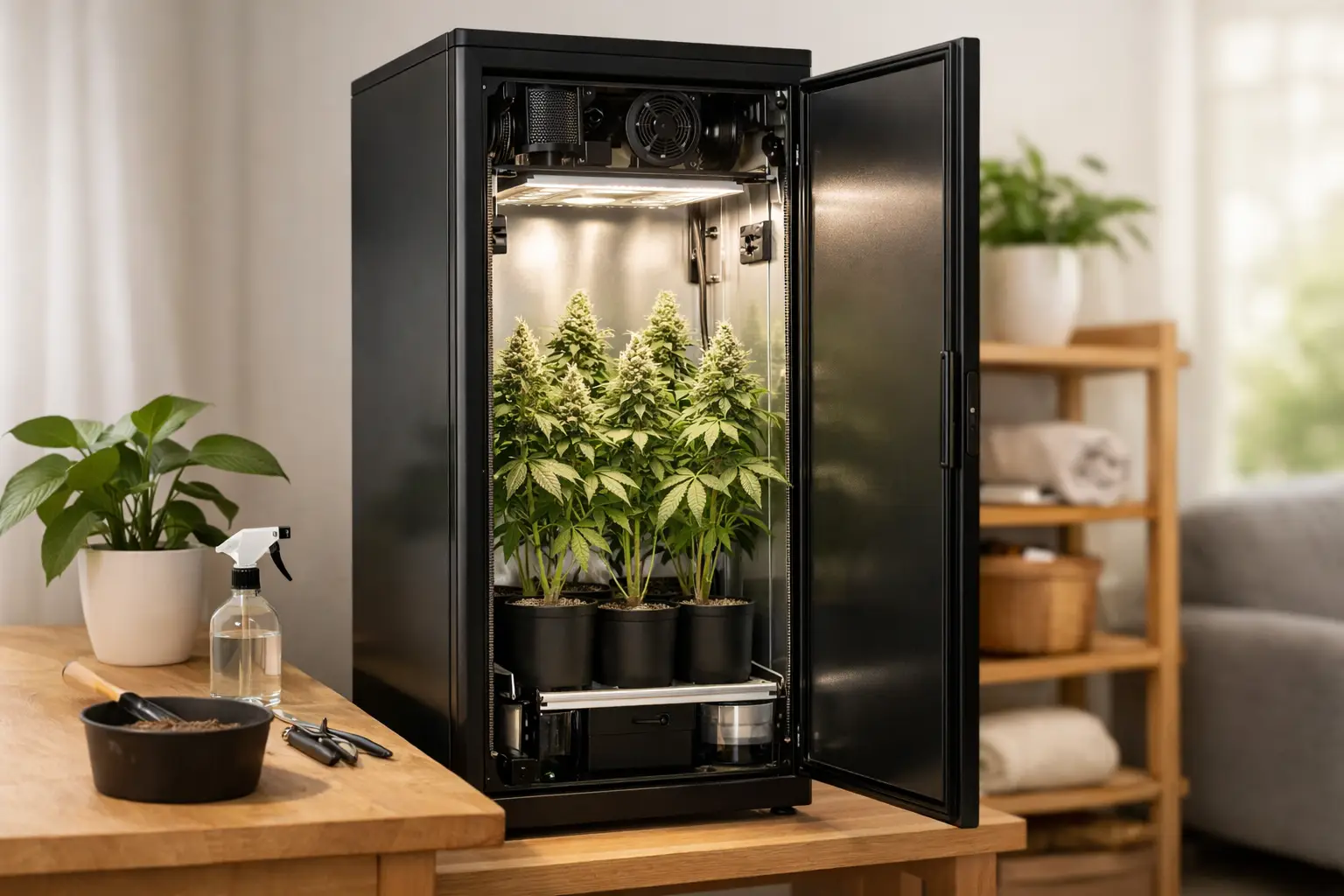
Small-space growing usually goes wrong before the seed ever cracks. The problem is rarely effort. It is mismatch - too much gear, the wrong method for the enclosure, and a plant strategy borrowed from growers with far more room than you have. This compact indoor cannabis grow guide is built around a simpler standard: fit the method to the space, keep the environment readable, and protect quality all the way through dry and cure.
That approach matters more in a cabinet, closet, or micro tent than it does in a large room. Compact growing gives you less forgiveness. Heat stacks faster. Humidity swings harder. Root-zone mistakes show up sooner. A crowded canopy becomes a maintenance problem overnight. If you want a clean first run, structure beats improvisation every time.
What a compact indoor cannabis grow guide should actually solve
A lot of beginner content treats small-space growing like full-scale cultivation with the dimensions reduced. That is how people end up chasing oversized plants, long veg times, and training plans that create more stress than control. In a compact enclosure, the real job is not to grow the biggest plant possible. It is to run a stable, finishable crop that your space can support from seed to jar.
That changes your priorities. You need an enclosure that can hold temperature and humidity without constant drama. You need a method that matches your ability to monitor it. You need a plant size that leaves room for airflow, watering or reservoir access, and sensible light distance. You also need the discipline to think past harvest day, because many first grows are damaged more in drying than they were during the entire cycle.
Start with enclosure logic, not shopping hype
Before you choose nutrients, genetics, or training, decide what your enclosure can realistically handle. In a compact setup, control is the product. Lights, fans, filters, and containers are only useful if they create a readable environment.
A cabinet-style setup can work extremely well when it is designed as a system, not a pile of parts. The same goes for a small tent. What matters is whether you can manage airflow, temperature, humidity, and plant height without fighting the space every day. If your light runs hot, your ventilation is weak, and your plant fills every inch of the enclosure by week three of flower, you do not have a cultivation problem. You have a design problem.
This is where beginners often overbuy. More gadgets do not create control. Better alignment does. A compact grow needs enough air exchange, enough vertical room to maintain safe light distance, and enough access to work cleanly. If basic maintenance feels cramped before the plant is even mature, that setup is already telling you something.
Method-to-space alignment matters more than method loyalty
There is no single best growing method in all situations. There is only the best fit for your space, routine, and tolerance for correction speed. Soil gives you a bit more buffer. DWC gives you fast growth and direct root-zone control, but it asks for consistency. In a compact environment, DWC can be excellent because it removes some media-related variability and keeps the workflow clean, but only if you are willing to monitor water temperature, reservoir condition, and plant response closely.
That is the trade-off. Hydro rewards discipline and punishes neglect faster. Soil is slower to correct but often slower to crash. If you are running a small cabinet and want a tidy, repeatable process, a simplified DWC setup can make a lot of sense. If you know you will miss checks and prefer more forgiveness, a smaller soil run may fit you better.
Keep the plant small on purpose
Compact growers get into trouble when they grow like they have unlimited ceiling height. They do not. Small-space success usually comes from plant size control, not heroic late-stage fixes.
One of the clearest ways to control scale is to flower early. A 12/12 from seed approach is not for everyone, but in tight spaces it solves a very real problem: overgrowth. You are not trying to build a huge frame and then wrestle it into submission. You are aiming for a manageable plant that can mature properly inside the enclosure you actually have.
That does mean accepting the trade-off. Smaller plants usually mean less total yield per run than a heavily vegged, trained plant in a larger space. But compact growing is not a max-weight contest. Craft quality, repeatability, and clean finishes matter more than squeezing every possible gram from a cabinet. A plant you can fully manage will usually outperform a larger one that runs too hot, too crowded, or too wet.
Read stretch before it becomes a problem
Early flower is where compact grows either stay organized or become a mess. If your cultivar stretches aggressively, the wrong response is to wait and hope it settles down. Watch internode spacing, canopy rise, and how quickly your safe light distance starts shrinking. Those are your signals.
A compact canopy should still breathe. If fan leaves are layering tightly, lower sites are trapping moisture, or your plant is leaning into the light because spacing is collapsing, you are already paying for too much biomass. In small spaces, restraint is a skill.
Build the grow around environmental readability
A healthy compact grow is readable. Leaves pray or relax normally. The reservoir or medium behaves predictably. Temperature and humidity stay in a range the plant can use. Problems do not appear as random drama. They show up as signals you can actually interpret.
That only happens when the environment is stable enough to tell the truth. If your cabinet is hot by day, damp by night, and overfilled from wall to wall, every symptom gets harder to diagnose. You will blame nutrients for what airflow caused, or chase pH when the root zone is actually stressed by heat.
This is why climate control deserves more attention than additive culture. A beginner with a plain setup and stable conditions will usually grow better flower than someone with premium bottles and sloppy environmental control. Clean air movement, sane humidity, manageable leaf mass, and root-zone consistency do more work than flashy inputs.
In compact hydro, root-zone discipline is not optional
If you run DWC in a cabinet or small tent, the root zone becomes part of climate management. Water temperature, dissolved oxygen, and reservoir cleanliness all affect how the plant handles the rest of the environment. Warm nutrient solution, stagnant conditions, and delayed maintenance can turn a healthy crop sideways fast.
The fix is not complexity. It is routine. Check the reservoir on a schedule. Watch for changes in uptake. Notice whether the plant is drinking more than feeding or feeding more than drinking. Look at roots before you guess. Compact hydro works well when you treat the root zone like a system to read, not a bucket to ignore.
The finish stage is where craft shows up
Plenty of growers can get a plant to harvest. Far fewer can preserve what they grew. In small-space cultivation, post-harvest discipline is often the line between decent flower and flower that actually smokes clean.
Harvest timing matters, but it is not the whole story. If you cut a nice plant and then rush the dry in a hot room or seal jars too wet, you have wasted the hard part. Compact growers need a finish plan before chop day, not after. Where will the plant dry? What humidity can you maintain? How will you avoid overdrying the exterior while the center stays wet?
Drying is not just waiting. It is controlled moisture loss. You want a gradual dry that protects aroma and lets chlorophyll break down without inviting mold. That usually means resisting the urge to speed things up with extra heat or aggressive airflow pointed directly at the flowers. Fast dry, harsh smoke. That pattern is common for a reason.
Curing is where patience stops being optional. If the flower goes into jars with too much internal moisture, you create a mold risk and flatten quality. If it goes in too dry, you do not get the same finish. The cure rewards growers who pay attention after the excitement of harvest fades. This is one of the main differences between a crop that looks good online and a crop that is actually enjoyable to use.
A simple compact workflow beats scattered advice
The strongest compact setups follow a sequence. First, build a controllable enclosure. Then choose a method that fits the space and your management style. Keep plant size within the limits of the environment. Read the plant through stable conditions, not chaos. Finish with the same discipline you used during the grow.
That is the real value of a structured system like the one ColaXpress teaches. It removes the noise that makes beginners second-guess every decision and helps you focus on what your space can support consistently.
If you are growing in a compact space, think like a craft grower, not a yield chaser. A smaller, cleaner run that finishes well will teach you more - and usually smoke better - than a crowded, overcomplicated first attempt.