How to Dry Cannabis Slowly and Cleanly
Learn how to dry cannabis slowly with better control, cleaner flavor, and fewer mistakes. Ideal for small indoor grows and compact drying spaces.
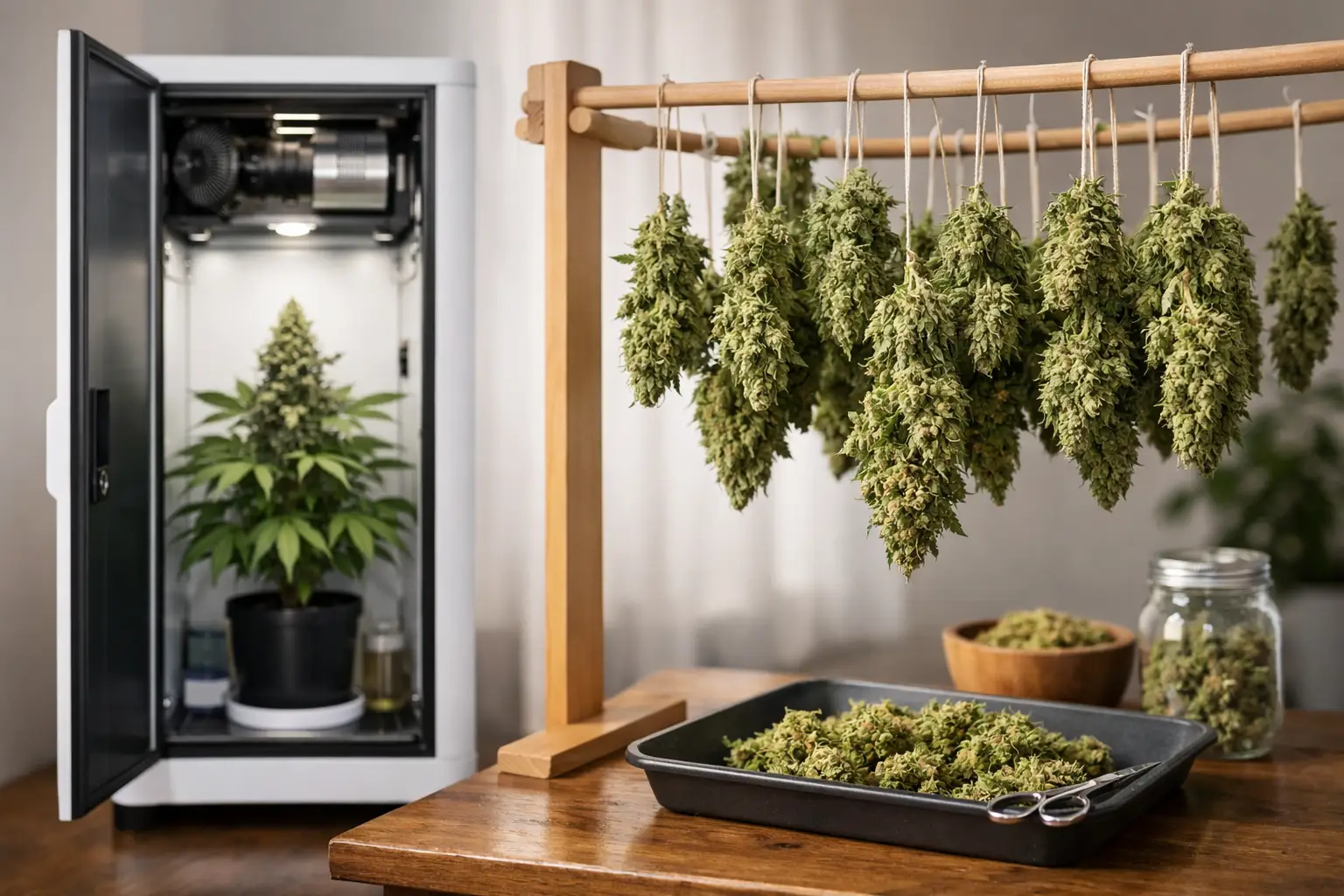
The fastest way to ruin a good harvest is to get impatient after chop. If you want to learn how to dry cannabis slowly, the goal is simple: hold the plant in a narrow environmental range long enough for moisture to leave evenly without cooking off aroma or trapping chlorophyll in the flower.
That sounds straightforward until you try doing it in a small tent, cabinet, closet, or spare room that swings hard between too wet and too dry. This is where growers lose quality. Not because the plant was weak, but because the finish was sloppy. Slow drying is not about waiting around. It is about control.
Why slow drying matters
A slow dry gives moisture time to move from the center of the bud toward the surface at a manageable pace. When the outside dries too fast, the flower can feel finished while the interior is still wet. That creates the classic bad finish: hay smell, harsh smoke, uneven cure, and buds that either stay spongy too long or crisp up on the outside and degrade fast in jars.
In a compact indoor grow, this matters even more. Small spaces respond quickly to weather, HVAC cycles, and dehumidifiers. A room that looks fine at noon can be too dry by evening. If you are growing in a cabinet or small tent, your dry room needs the same discipline as your flower cycle. This is part of the grow, not an afterthought.
How to dry cannabis slowly in a small space
For most home growers, the target is a dark space around 60 degrees Fahrenheit and 60% relative humidity, with gentle air exchange and no fan blowing directly on the flowers. People repeat 60/60 for a reason. It is not magic, but it is a reliable center point that slows the process enough to preserve quality without inviting mold.
If you cannot hit that exactly, get close and favor stability over perfection. A steady 62 to 65 degrees with 58 to 62% humidity is usually far better than a space bouncing between 55 and 72 degrees and 45 to 70% humidity. Drying is not won by chasing numbers every hour. It is won by creating a stable lane and keeping the flowers inside it.
Hang whole plants or large branches if your space allows. More plant mass slows moisture loss, which is usually what you want. If your environment runs humid and you are dealing with dense flowers, smaller branches may be safer. This is one of those places where it depends. In a dry apartment, whole-plant hanging can save a harvest. In a sticky late-summer room with weak dehumidification, it can drag things out too long.
Air movement is where people get reckless
You need air exchange, not wind. A small oscillating fan pointed away from the hanging plant is fine. A fan blasting buds is not. Direct airflow hardens the exterior too fast and pushes you toward an uneven dry.
Think of the room in layers. You want stale, humid air replaced gradually, but you do not want the flower whipped dry at the surface. In a tent or cabinet, exhaust should be gentle and continuous or at least controlled in a way that avoids major swings. If your exhaust setup strips humidity too aggressively, you may need to reduce fan speed, add a humidifier to the lung room, or dry in a slightly larger buffer space.
Wet trim or dry trim?
If your goal is to dry cannabis slowly, dry trim usually gives you more margin. Leaving more leaf on the flower slows the rate of moisture loss and protects the bud surface during the dry. It also makes the process more forgiving in small spaces that run a little dry.
Wet trimming has a place, especially if your environment is already humid and you are trying to reduce mold risk. But it speeds the dry. In a tight indoor setup, that can turn a decent finish into a three- or four-day rush job. If your room trends below 55% RH, wet trimming is usually working against you.
This is the craft-first answer: do not choose a trimming style based on convenience alone. Choose it based on what your drying environment is likely to do.
The timeline most growers should expect
A proper slow dry often takes 7 to 14 days. Sometimes a little shorter, sometimes longer. Dense buds on full branches in a stable room can push toward the longer end. Smaller flowers, aggressive trimming, or lower humidity can compress the schedule fast.
Do not chase a fixed day count. Read the flower. The outside should gradually lose that fresh-cut wet feel. Small stems may begin to snap, but not like dry twigs. Larger stems often still bend a bit when the buds are ready to move into cure. If you wait for every stem to snap hard, many home growers overshoot and end up with flower that is already too dry.
The better test is combined feel. Buds should feel dry on the outside, slightly springy, and no longer cold-wet in the center when broken down. If they feel brittle, you are late. If they feel soft and damp all the way through, they are early.
Mistakes that speed the dry too much
Most bad drying comes from one of a few predictable mistakes. None of them are complicated. They are just common.
The first is drying in the same environment you used for late flower without adjusting it. Flowering rooms are often warmer, brighter, and more ventilated than a good dry room. That setup grows buds well but finishes them badly.
The second is overusing equipment. Strong inline fans, constant dehumidification, or space heaters can make the room look controlled while they are actually stripping moisture too fast. Gear is not the solution if the workflow is wrong.
The third is breaking plants down too small. Individual buds on racks dry fast. Sometimes too fast. If the room is not very humid, that speed costs you aroma and smoothness.
The fourth is checking too often with the room open. Every time you open a small drying space, you disturb the environment. A quick daily check is enough unless something is clearly off.
Troubleshooting a dry that is moving too fast
If the room drops below the mid-50s RH and the buds are drying faster than planned, act early. Add humidity to the broader room if possible rather than blowing mist directly into the drying space. Reduce exhaust intensity if odor control and fresh air still remain adequate. If you have already trimmed heavily, accept that your margin is smaller and monitor closely.
Some growers try to rescue a too-fast dry later in jars with humidity packs. That can make the flower feel less brittle, but it does not recreate a proper slow finish. Texture can improve. Lost aroma development usually does not fully come back.
If the dry is moving too slowly and the room is stuck above the low 60s RH, increase air exchange carefully and remove excess plant material if needed. Watch dense colas closely. Slow is good. Stagnant is not. There is a difference between preserving quality and inviting mold.
When to jar after you dry cannabis slowly
Once the flowers reach that dry-outside, slightly springy stage, move them into jars or another curing container and watch internal humidity. If the jar humidity rises sharply into the upper 60s after a few hours, the flowers were still too wet. Take them back out and give them more drying time.
If the jar settles around 60 to 65% and stays stable, you are in a good range to begin cure management. This is where a slow dry pays off. The flower enters cure with moisture distributed more evenly, which makes the next stage calmer and more predictable.
For small-space growers, this matters because predictability is the whole game. You do not need giant plants or a pile of gear to get clean flower. You need a finish process that matches your space and a willingness to stay disciplined when the temptation is to rush.
The real standard
Learning how to dry cannabis slowly is really learning how not to panic at the finish line. Good drying is quiet, boring, and controlled. That is exactly why it works.
Treat the dry like part of the cultivation system, not the leftover phase after harvest. If you can hold a stable environment, leave enough plant mass to slow moisture loss, and stop trying to force the timeline, your flower has a real chance to smell like the plant you actually grew. That is the standard worth protecting.