Troubleshooting

Cannabis Troubleshooting: Diagnose Plant Problems Fast

Something's wrong with your plant and you need an answer now. Start with what you can see — yellow leaves, brown spots, white powder, drooping, mold — and let the picture take you to the cause. Each guide below pairs real diagnostic photography with the one signal that separates a problem from its look-alike, so you fix the right thing the first time.

The fastest split in all of diagnosis: did it start on the old, lower leaves or the new, upper growth? That one question halves your options before you touch anything.

Narrow it first

Three questions cut the list before you open a single guide.

Most wrong diagnoses come from starting with the symptom's name instead of its address. Where the damage sits rules out more causes than what colour it is. Work through these in order and you are usually down to one or two candidates before you read anything.

Age

Old growth or new growth?

Trouble that starts on the old, lower leaves points at the mobile nutrients — nitrogen, magnesium, potassium, phosphorus, which the plant pulls upward to feed new growth. Trouble that starts on the new, upper growth points at the immobile ones — calcium, iron, sulfur. That one question halves the deficiency list.
Place

A place on the plant, or a place in the room?

A feeding problem moves by mobility, so it tracks the veins and the age of the leaf. Environmental stress sits wherever the heat, light, wind or water actually reached — the tops nearest the lamp, the leaves in the fan's path. When the damage maps to a spot in the room, fix the room, not the feed.

Feel

Flat colour, or something with texture?

Deficiency colour lies flat on the leaf. Fine dot stippling, silvery smeared scarring, silk webbing, powder you can rub off, or grey collapse inside a bud all mean something is living on the plant. Turn a few leaves over before you decide it is nutrition.

Start here

Find the problem by what you see.

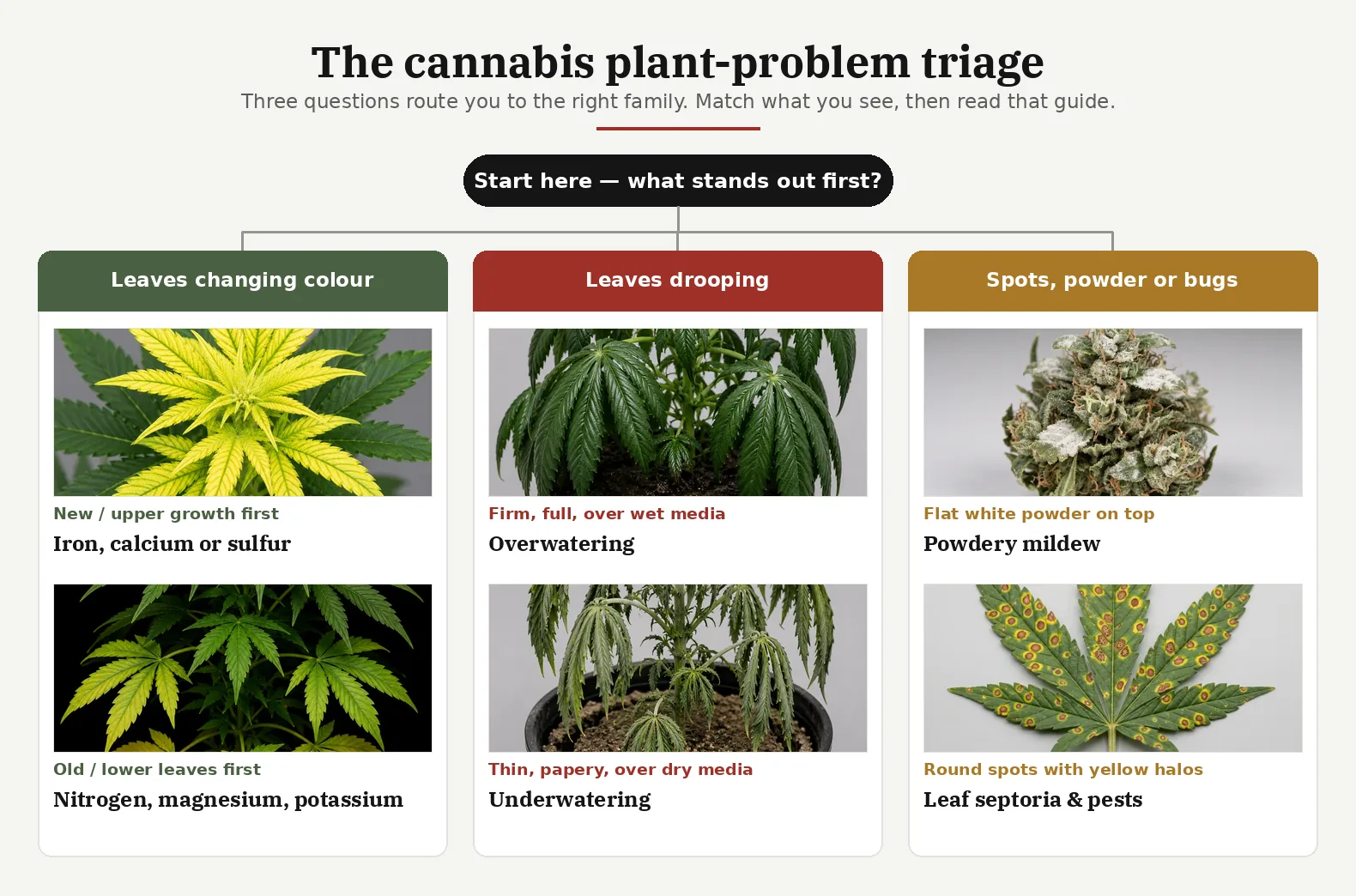
Three questions get you to the right family fast: is a colour changing, is the plant drooping, or are there spots, powder or bugs? Match the cue, then open that guide below.

Triage board splitting 'what stands out first?' into three columns, colour change, drooping, and spots or bugs, each with labeled plant photos.
Start from what stands out first — colour change, drooping, or spots/powder/bugs — and each visible cue routes you to the right family to investigate.

Nutrient deficiencies

Yellowing, spotting, and discoloration mapped to nitrogen, magnesium, calcium, potassium, phosphorus, iron, sulfur, and pH lockout — with early/moderate/severe macros for each.

Bud rot & mold

Spot botrytis and powdery mildew early — how rot hollows a cola from the inside, what mildew looks like as it spreads, and which flower to discard.

Pest damage

Read the bug off the leaf — thrips silver scarring versus spider-mite stippling, with early, moderate, and severe thrips macros and the texture tests that name each pest.

Environmental stress

Heat, light, cold, wind, and water read off the plant by direction and location — overwatering versus underwatering droop, light burn on the tops, cold purpling, and wind burn.

Root problems in DWC

Healthy white roots versus brown, slimy root rot — the severity ladder, and how to tell harmless staining from real rot before you panic.

Slow growth & watering

Over- versus under-watering (firm droop versus papery wilt) and the other reasons a compact grow loses pace.

Humidity & environment

When the cabinet keeps turning heavy or wet — the environmental drift behind mold, slow growth, and stress symptoms.

Common beginner mistakes

The errors that show up again and again in compact runs — and what the plant actually looks like when each one happens.

Symptom to suspect

What you are looking at, and which page actually answers it.

Find the row that matches your plant, confirm it against the "where it sits" column, then open the guide in the last column. If two rows both look plausible, the second column is the tiebreaker — location is harder to misread than colour.

What you see Where it sits Where to read it
Yellowing that climbs from the bottom Old, lower leaves first — whole leaf fading, or yellow between veins that stay green Nutrient deficiencies
Pale or bleached new growth Top growth only, with the veins either still green or gone pale along with the leaf Nutrient deficiencies
Brown spots with hooked, twisted tips New growth at the growing points, not the old canopy Nutrient deficiencies
Several conflicting symptoms at once No single pattern holds — interveinal yellowing, spots and burnt tips together pH lockout
The whole plant is drooping Firm and heavy over wet media, or thin and papery over dry media Watering stress
Clean pale-to-white tops Only the leaves nearest the lamp, with a sharp gradient back to green just below Light burn
Leaves cupping upward into a taco The hottest zone at the top of the canopy Heat stress
Clawed, tattered leaves in one patch Only along the fan's airflow path; the rest of the plant is normal Wind burn
Purpling on a plant that is otherwise thriving Blades and stems flush while growth stays strong Cold purpling
Fine dot stippling, later silk webbing Leaf undersides first, then between the leaflets Pest damage
Silvery smeared scarring, not dots Across the leaf surface Pest damage
Small flies around the media The root zone — larvae in the medium rather than marks on a leaf Pest damage
White powder on leaves, or grey collapse inside a cola Leaf surfaces, or hidden in the densest flower Bud rot & mold
Brown, slimy roots under a drooping plant The reservoir, below the water line Root rot
The pairs that get confused

Four look-alikes cause most of the wrong fixes.

These are the ones where the obvious reading and the correct reading point in opposite directions. Each pair has a single tell that settles it.

Overwatered against underwatered

Both droop the whole plant, and the reflex — pour more water — is wrong half the time. Overwatered leaves fold down firm, full and dark over wet media. Underwatered leaves hang thin, limp and papery over media that has pulled back from the edges. One droop is turgid, the other is weightless. Feel the leaf before you reach for the jug.

Light burn against a feeding problem

Light burn is location damage: bleaching on the leaves closest to the lamp, a sharp gradient to healthy green just below, and no vein pattern anywhere. A nutrient problem moves through the plant by mobility instead of stopping dead at the canopy line. If there is a clean top-only boundary, raise the light before you touch the feed.

Cold purple against phosphorus purple

Cold flushes blades and stems on a plant that is otherwise growing well. Phosphorus turns the older leaves dark, dull and blue-green with red-purple petioles, on a plant that has visibly slowed. Purple on its own proves nothing — genetics do it too. Read the vigour alongside the colour.

Thrips against spider mites

Thrips leave silvery scars that smear across the leaf surface. Spider mites leave fine dot stippling that later turns to silk webbing between the leaflets. Dots and webbing mean mites; smeared silver means thrips. They call for different responses, so name it before you spray anything.

Before you change anything

Move one variable at a time, or you will never learn what worked.

The fastest way to make a small grow worse is a panic stack: raise the light, cut the feed, dump the reservoir and add a fan all in one evening. If the plant recovers you have learned nothing, and if it declines you now have four suspects instead of one. Change one thing, note the date, and give the plant long enough to answer.

  • Check pH before you decide a nutrient is missing. Several contradictory symptoms at once usually mean lockout rather than a shortage.
  • Burnt and dead tissue never turns green again. Judge a fix by whether the new growth comes in clean, not by whether the damaged leaf recovers.
  • Photograph the same leaf under the same light each day. Your memory of what it looked like on Tuesday is a worse instrument than your phone.
  • Mold is the one problem where waiting to see costs you the rest of the plant. Get it out of the space rather than watching it.

Most of what lands on this page could have been caught a week earlier by looking. The short daily walk-past routine is the cheapest insurance in the whole workflow.

Not every symptom is big enough to have earned a page here. If what you are looking at is narrower than anything above — one reading that drifted, one leaf behaving oddly while the rest of the plant carries on — field notes from actual runs tend to cover that kind of thing at the length it deserves.

See them side by side

Browse the diagnostic image library.

Every symptom macro lives in the Troubleshooting gallery — a consistent, labeled set built so you can match your plant to the picture in seconds rather than guess. It is the right place to go when you can see that something is wrong but cannot yet put a name to it: scroll the grid, find the frame that matches, and follow it back to the guide that explains it.