Compact craft growing

A small space cannabis grow can protect craft quality when the method stays clear.

A compact craft cannabis grow is not just a cannabis plant living in a smaller cabinet, closet, or corner. It is a small-space grow built around readable plant structure, cleaner environmental control, and a finish plan that exists before the room starts making demands. Small rooms do not automatically make better flower. They simply make weak decisions easier to expose.

Compact growing becomes craft when the room is small enough to stay honest and the grower is disciplined enough not to ask it to lie. The reward is not maximum size. The reward is flower whose method, harvest, and finish still make sense once the jar opens.

What compact protects Readability, contained climate, cleaner plant structure, and a finish path that can stay visible.
What compact punishes Oversized plant plans, sloppy airflow, environmental drift, and late-stage improvisation.
What makes it craft Smaller decisions, calmer corrections, and flower that still feels composed after harvest, drying, and cure.
Why compact can work

Small rooms can support craft unusually well because they make weak process visible sooner.

Most small-space growing advice focuses on survival: keep the light from burning the canopy, keep odor from escaping, keep humidity from drifting, keep the plant from outgrowing the footprint. All of that matters. But the deeper advantage is philosophical. A compact room makes the system easier to read when the setup, method, and finish all belong to the same idea.

That is why ColaXpress keeps favoring compact systems that stay legible under pressure. When the enclosure is contained, the method is sized honestly, and the finish plan exists early, a small room can become one of the cleanest places to grow craft cannabis. It will not hide contradiction well. That is exactly why it can protect quality well.

A calmer compact room usually creates a calmer last third of the run. The plant finishes with less crowding, the harvest call feels less emotional, and the jar is less likely to reveal that the room spent the whole grow pretending to be larger than it was.
Field note

Compact rooms do not create craft by themselves. They simply make the truth harder to delay.

  • Less room for denial
  • Less room for oversized methods
  • More pressure to build the finish early
The four-stage logic

A compact craft run works when the room, method, harvest, and finish all stay in scale with each other.

Stage 1 Contain the room

Light, airflow, odor, and climate belong to one enclosure so the environment stays easier to interpret.

Stage 2 Control the method

The plant structure, training posture, and root-zone method fit the footprint instead of fighting it.

Stage 3 Read the harvest

The cut is made by maturity and finish readiness, not by crowding, panic, or calendar fatigue.

Stage 4 Protect the finish

Drying and cure are already planned, so the flower is not asked to survive a rushed handoff after a good grow.

Compact craft protects

Signal clarity, cleaner structure, and a finish path that can still stay honest all the way to the jar.

  • Plant size that respects the cabinet instead of testing it
  • Smaller environmental corrections because the room stays readable
  • Harvest decisions made by maturity instead of by crowding stress
  • Drying and cure already accounted for before the plant gets loud
Compact max-weight spends

Readability first, then stability, and finally finish quality once the room starts carrying more than it should.

  • Canopy control gets noisier because structure outruns the footprint
  • Airflow and humidity start solving problems that should not have existed yet
  • Harvest timing drifts toward relief instead of readiness
  • The jar gets asked to repair a room that was already compromised
What compact rooms do well

Compact rooms can make light, airflow, root-zone behavior, and daily rhythm easier to read.

  • Light management: canopy distance and intensity stay easier to judge when the plant is kept honest.
  • Odor and airflow: containment forces the grower to think about movement and filtration early instead of late.
  • Root-zone readability: compact hydro and DWC setups answer quickly when something drifts.
  • Daily discipline: a smaller run usually makes it easier to notice pattern instead of chasing random signals.
What compact rooms punish immediately

They expose oversized methods, climate laziness, and finish-stage fantasy much faster than larger rooms do.

  • Plant height denial: a plant that ignores the footprint creates stress faster in a cabinet than in an open tent.
  • Humidity drift: smaller enclosures magnify weak airflow and weak dry planning.
  • Training excess: methods that need more space and recovery become noisier in compact rooms.
  • Finish procrastination: there is nowhere to hide if harvest, drying, and cure are still imaginary when the room gets close.
Compact vs max weight

The smaller room becomes craft-friendly when the grower stops trying to make it perform like a louder, bigger system.

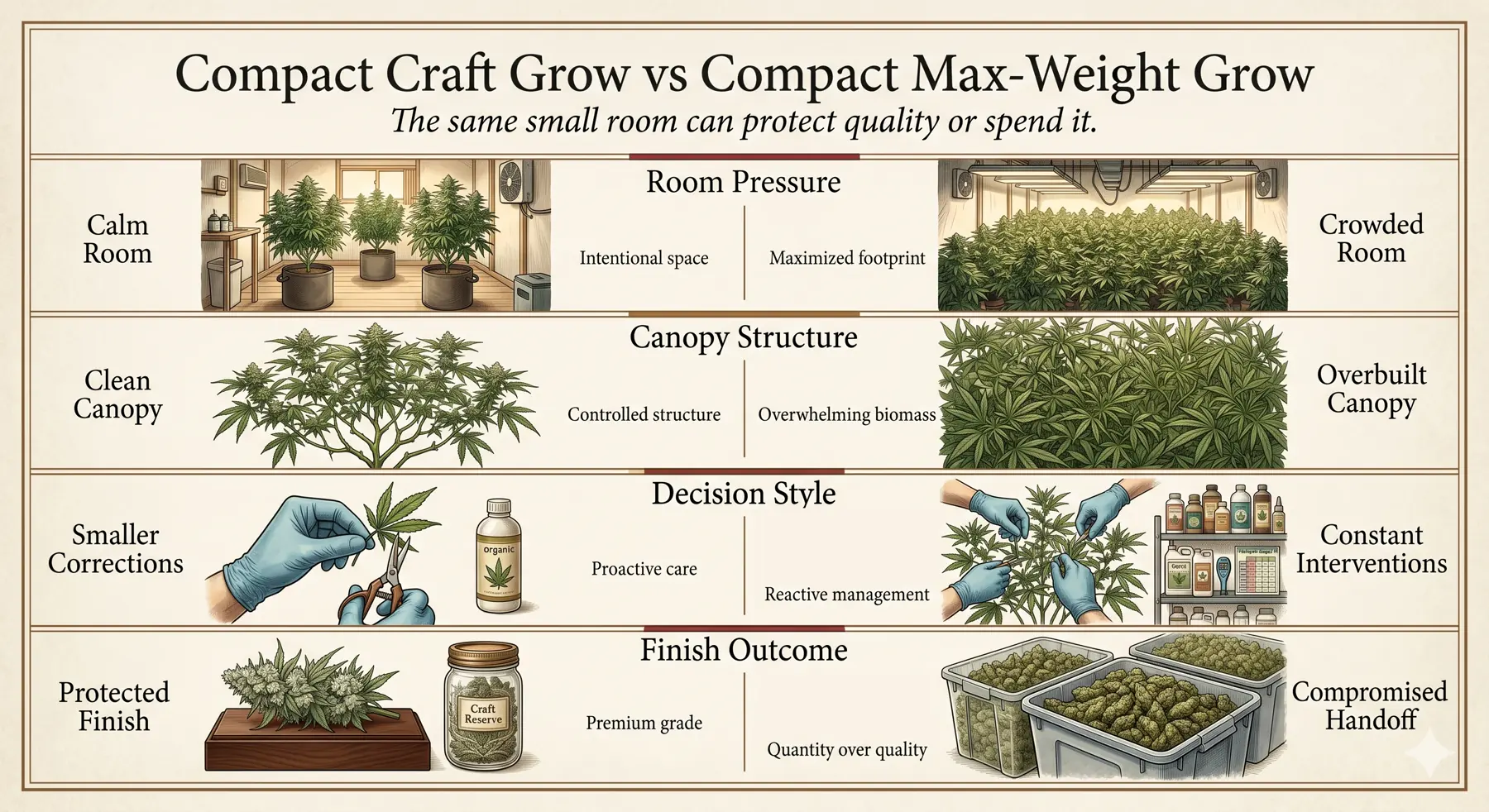
Comparison board showing compact craft growing versus compact max-weight growing across room pressure, canopy structure, decision style, and finish outcome.
The contrast gets easier to trust when the same small room is shown protecting clarity on one side and spending it on the other.
Category Compact craft approach Compact max-weight approach
Plant size Structure stays small enough that the room can still be read honestly. The plant is pushed until the room starts negotiating with it.
Training posture Only enough shaping to keep structure clean and manageable. More training, more correction, and more recovery pressure stacked into less space.
Light management Canopy stays in a range the fixture can support without drama. Stretch and crowding make light distance part of the conflict.
Odor and airflow Built into the plan from the start as part of stability. Often treated like a problem to patch only after the room gets louder.
Root-zone reading Signals stay cleaner because fewer plant and room contradictions are stacked on top. Root issues get harder to separate from room stress and training stress.
Harvest timing Cut because the flower is ready. Higher risk of cutting because the room is crowded, hot, or impatient.
Drying and cure planning Part of the build from day one. More likely to be treated as what happens after the "real" grow is over.
Success looks like Finished flower with clarity, composure, and a finish that still matches the method. A room that produced more plant than the finish can comfortably honor.
What makes it craft-first

A compact grow starts feeling craft-first when the room gets calmer, not louder, as the run matures.

Structure

Readable plant structure

The plant fits the footprint, the canopy remains legible, and the room is not being forced to carry theater it never agreed to.

Rhythm

Cleaner daily decisions

Monitoring, feeding, and environmental adjustments stay smaller because the room is not already overwhelmed.

Finish

Calmer finish path

Harvest, drying, and cure feel like the next stage of the same system instead of a rescue operation after it.

That calmer finish path is the whole point. When the room stayed honest, the flower usually reads quieter in the last stretch too: trichome checks feel more decisive, drying feels less defensive, and the cure is more likely to settle into clarity instead of arguing with hidden moisture, stress, or haste.

Methods that fit the room

The strongest compact craft methods are the ones that respect containment instead of fighting it.

This is why ColaXpress keeps returning to 12/12 from seed, direct root-zone methods like DWC, and the flagship VGrow DWC path. These methods do not win because they sound sophisticated. They win because they make the room easier to read, the plant easier to manage, and the finish easier to protect.

The broader system logic behind that lives on grow system. The shorter version is simple: compact craft gets stronger when the method makes the next decision easier instead of harder. When the method fits but plant choice still feels fuzzy, the clean follow-up is best cannabis strains for small spaces. If the method fit itself feels shaky, the counterweight is when 12/12 from seed is a bad idea so the flagship path does not turn into dogma.

Methods that fight the room

Compact rooms get weaker when the grower asks them to carry sprawling ambition instead of disciplined structure.

A cabinet or small enclosure is a bad place to insist on giant-plant expectations, layered correction, or training-heavy chaos just because the room looks controlled from the outside. That is where compact growing turns from craft into argument. The system becomes louder, the decisions become less trustworthy, and the finish starts paying for earlier excess.

  • Long veg in a cabinet that wanted shorter structure: the room starts spending control on height management instead of quality.
  • Training-heavy runs that never stop recovering: the plant keeps healing instead of simply finishing.
  • Trying to carry too much plant mass under one compact light path: the canopy stops reading cleanly and the room starts negotiating with hot spots and shade.
  • Pretending the finish can wait because the cabinet still looks tidy: the visual neatness of the room hides the fact that harvest, dry, and cure still have nowhere stable to land.
Who this fits

This is strongest for growers who care more about finished flower than about turning a small room into a performance.

  • Growers who want the room to stay readable instead of impressive.
  • Readers who mean process and finish when they say craft.
  • Beginners who would rather understand one contained system deeply than collect scattered advice.
  • Anyone building around cabinets, closets, or other honest small-space limits.
Who should skip it

This is weaker for growers who still want the room to impersonate a much bigger one.

  • Anyone chasing the biggest possible plant as the main proof of success.
  • Growers who enjoy sprawling, training-heavy runs more than readable compact ones.
  • People who still treat drying and cure as optional polish instead of part of the method.
  • Readers who want craft as a mood without accepting the restraint that keeps it real.
What compact craft is not

Compact craft is not tiny for the sake of tiny. It is small enough to stay honest and disciplined enough to stay worth finishing.

Boundary line

It is not stealth chaos inside a nicer cabinet. It is not underpowered gear with no finish path. It is not a max-yield fantasy stuffed into a footprint that was trying to stay clean. Compact craft is a room-size decision, a method decision, and a finish decision all at once.

That is why this page belongs beside craft cannabis cultivation and the VGrow DWC guide. One explains the philosophy. One explains the flagship hardware workflow. This page explains why compact scale can actually make both of those ideas easier to keep honest.

The one-line version

Compact craft works when the room stays honest enough that the jar never has to explain it away later.