Craft cannabis guide

What is craft cannabis from a grower's point of view?

Craft cannabis usually refers to flower shaped by smaller batches, more careful handling, and closer attention during growing and finishing. The term gets used loosely, though, which is why the real meaning matters: craft is not just a premium mood or a nicer label. It is cannabis whose method, harvest, drying, and cure can survive scrutiny.

Small batch is a scale. Craft is a discipline. The word only earns its weight when the process stops asking packaging to cover what the room failed to protect.

What craft means Attention, restraint, and finish quality that can still be felt after the flower leaves the room.
What dilutes it THC worship, boutique language, and small-batch branding with no real proof behind it.
What proves it Readable cultivation, honest harvest timing, careful drying, and a cure that settles instead of shouting.
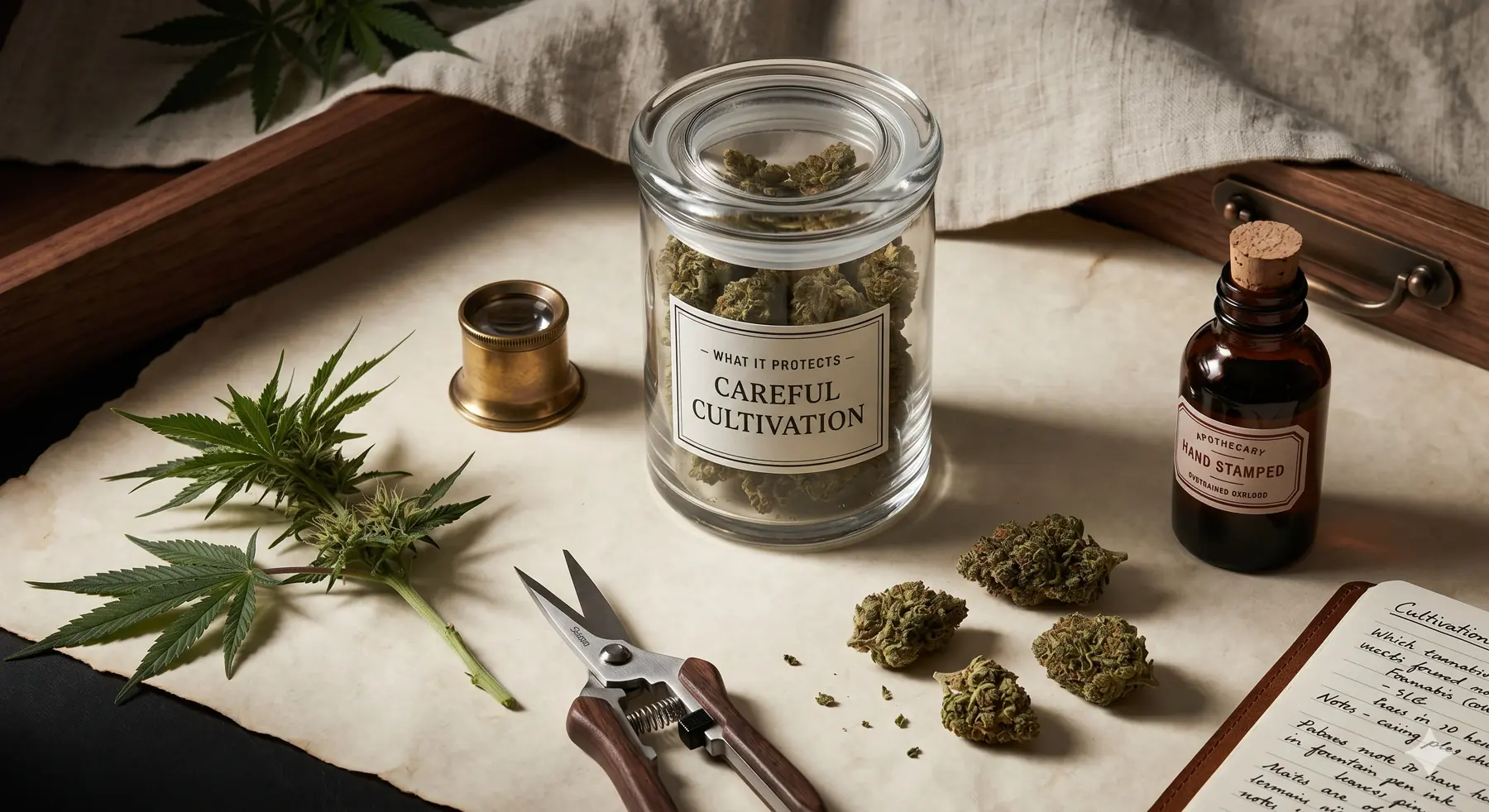
Editorial still life of a labeled glass cannabis jar, brass loupe, pruning shears, an amber apothecary bottle, a fresh sprig, and handwritten notes.
Craft becomes easier to trust when the visual language points back to handling, finish, and process instead of shelf noise.
Definition

Craft cannabis is not defined by being expensive, local, or photogenic. It is defined by how much of the process stayed careful all the way through.

Consumers usually meet the term through retail menus, dispensary copy, or producer branding. In that world, craft often gets attached to words like premium, terpene-rich, hand-trimmed, small batch, or limited release. Those things may point in the right direction. None of them settle the question on their own.

The cleaner definition is harder and more useful. Craft cannabis is flower whose growing, harvest, drying, and cure were handled with enough discipline that the final jar does not feel like a rescue mission disguised as luxury.
Field note

Craft is not a category that certifies itself. It is a promise the process either keeps or breaks.

  • Method that stays readable
  • Harvest that is not rushed
  • Finish that does not need excuses
Why the term gets abused

Craft sounds expensive, careful, and rare, which makes it easy marketing language even when the process underneath is only partly worthy of it.

The market likes the word because it can signal quality without having to explain the room, the handling, or the finish. That is why so many definitions stop at scale or presentation. Small batches, hand-trimming, or premium packaging are easy to advertise. They are much easier to advertise than patience, post-harvest restraint, or a cure that was not rushed.

That does not make the word useless. It just means the reader has to separate shelf language from actual process. Craft becomes meaningful only when it is tied back to what was done, when it was done, and what the flower still feels like because of it.

What usually gets mistaken for proof
  • Small batch: a scale, not a verdict.
  • Hand-trimmed: a handling choice, not a complete philosophy.
  • Premium branding: good design can still wrap average flower.
  • High terpene or THC claims: useful signals sometimes, but never enough by themselves.

The quieter truth is that craft usually reveals itself through fewer contradictions, not louder claims.

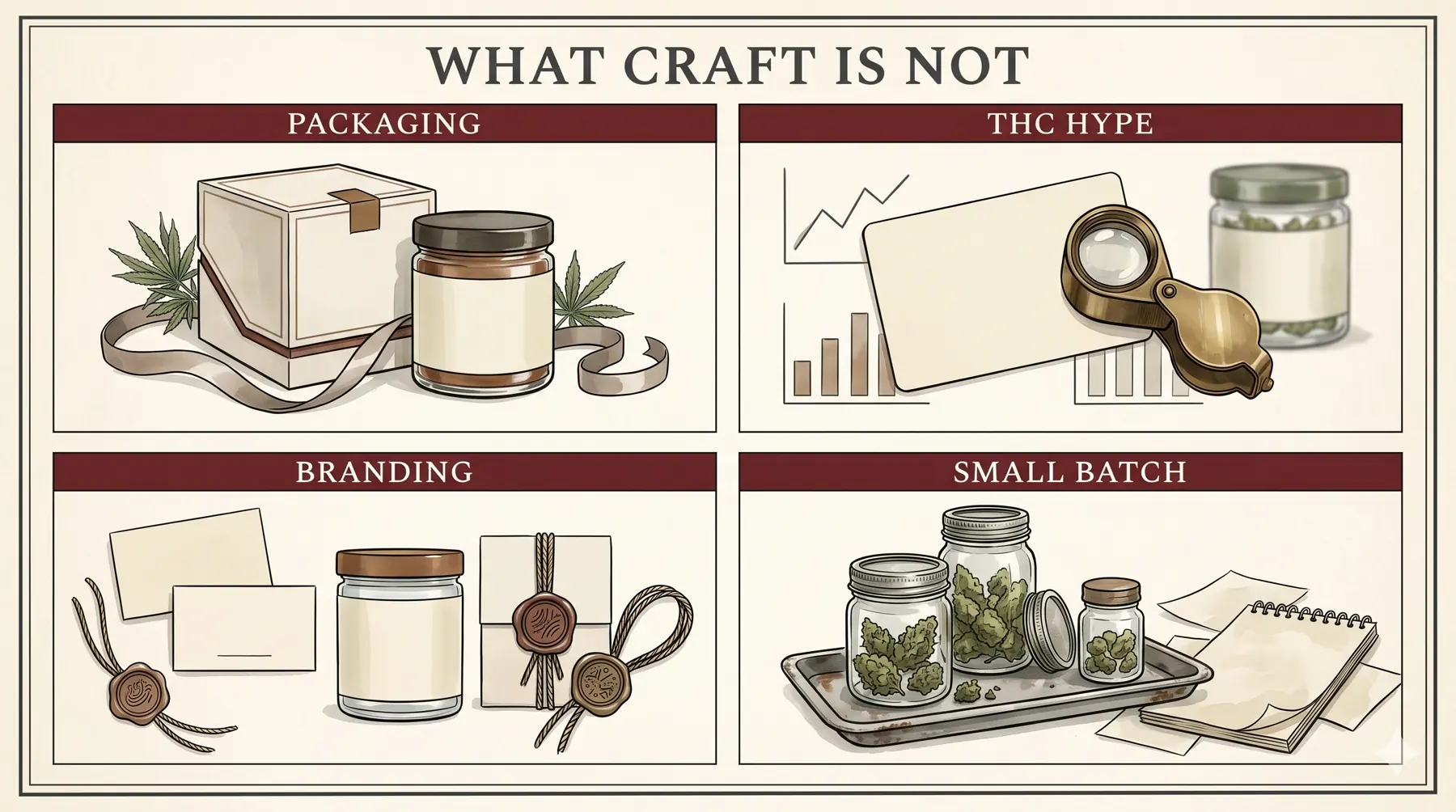
Illustrated 'What Craft Is Not' board with four quadrants — packaging, THC hype, branding, and small batch — each drawn as a mere shelf-appeal cue.
Packaging, potency language, branding, and small batch claims can all be real details. None of them proves craft without the process underneath.
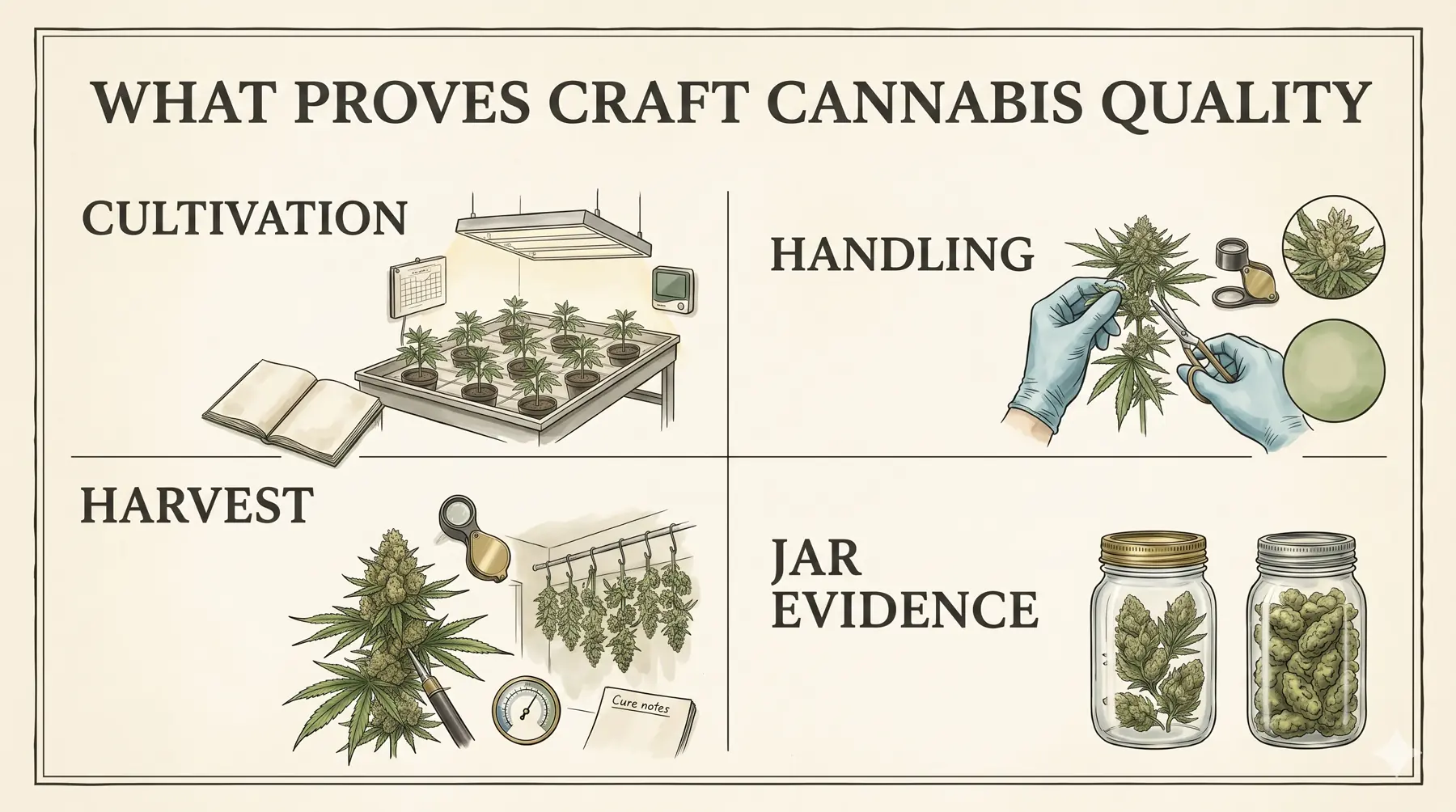
Illustrated 'What Proves Craft Cannabis Quality' board with four quadrants — cultivation, handling, harvest, and jar evidence — as the proof signals.
The proof is not one dramatic claim. Craft becomes believable when the method, handling, harvest, and final jar all tell the same story.
Comparison

The difference becomes easier to trust when craft and commercial logic are put side by side.

Category Craft cannabis Commercial / max-weight logic
Batch logic Smaller enough to keep handling, timing, and finish more visible. Optimized around throughput, consistency at scale, or volume pressure.
Grow posture Readable room, controlled method, fewer stacked corrections. More temptation to push size, speed, and recovery work.
Harvest posture Cut by maturity and condition. More likely to feel schedule-, room-, or throughput-driven.
Drying and cure Treated as part of the product's identity. More likely to be handled like a downstream step that simply has to finish.
What gets marketed Method, handling, terpene expression, batch character. Numbers, speed, broad consistency, availability.
What success feels like Flower with structure, aroma clarity, composure, and a finish that holds together. Flower that may still be competent, but often reads more optimized than protected.

If you want the fuller comparison page instead of the short version on this guide, go next to the full craft-versus-commercial breakdown.

How to spot it

Craft is easier to recognize when you stop looking for hype language and start looking for signs of handling discipline.

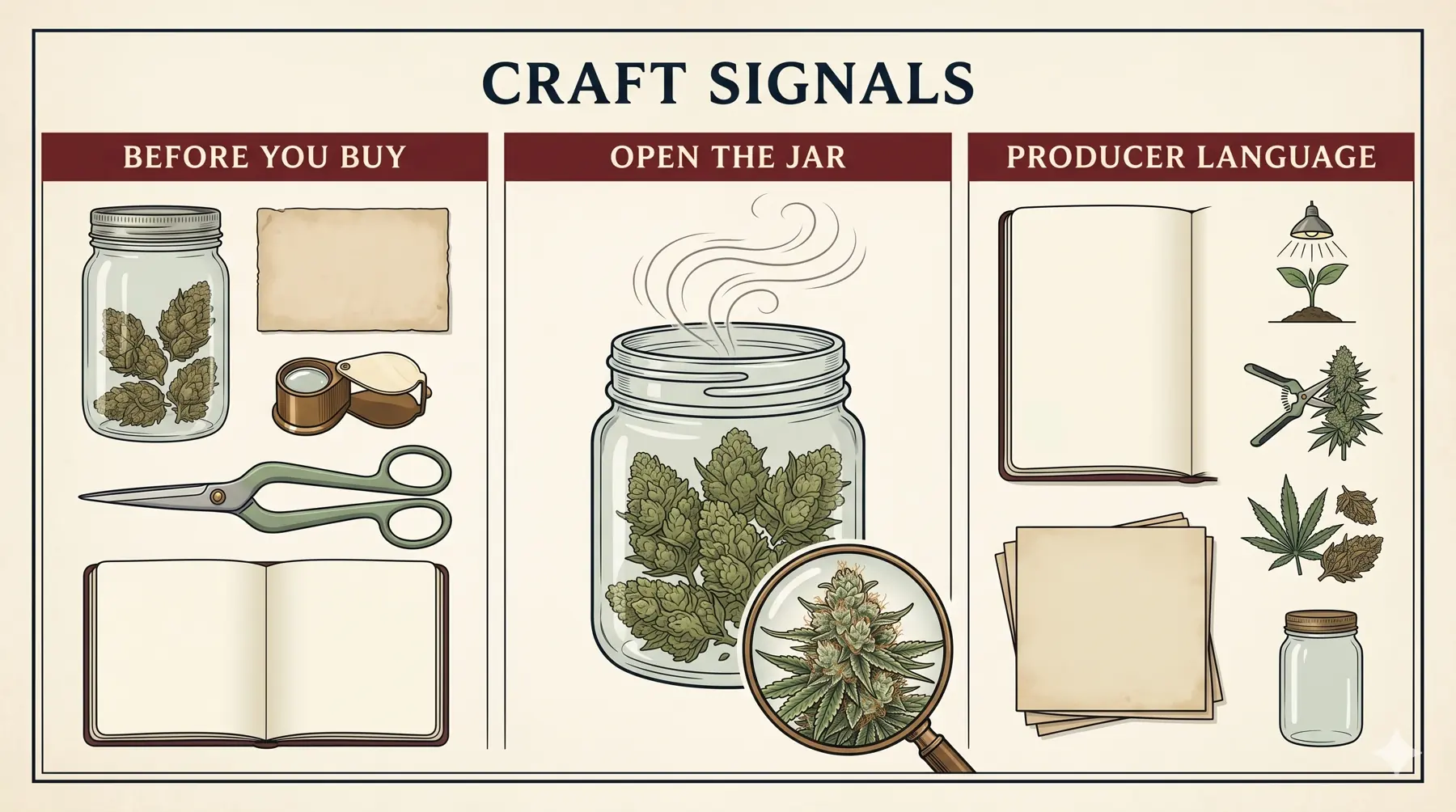
Illustrated 'Craft Signals' panel in three columns — before you buy, open the jar, and producer language — with jars, a loupe, and notebooks.
Once the proof framework is clear, the spot-check becomes practical: read the buying cues, the open jar, and the way the producer talks about process.
Buy

Before you buy

Look for producers who talk about batches, handling, drying, cure, and process decisions instead of relying entirely on a potency flex and an adjective pile.

Jar

When you open the jar

Craft usually reads calmer: clearer aroma, better moisture balance, less hay panic, less brittle drama, less evidence that the finish had to be forced.

Talk

What they emphasize

The more the story revolves around method, maturity, and finish, the more believable the word becomes. The more it leans on image alone, the weaker the case gets.

None of those signals is magic on its own. The useful pattern is consistency. Craft usually feels like the producer knew what mattered before the label existed. The language, the handling, the structure, and the finish all point in the same direction instead of trying to borrow credibility from one glamorous detail.

What it means to growers

For growers, craft stops being a label and becomes a standard for how the room is run.

This is where the broader term has to reconnect to cultivation. If the room is noisy, the method is oversized, the harvest is rushed, or the cure is improvised, the flower cannot be repaired into craft afterward. The process has already spoken.

That is why this guide does not stop at the shelf definition. The cultivation discipline below translates the broader idea into actual room logic, method fit, and finish discipline, where the word can finally be tested.

Why finish belongs in the definition

Harvest, drying, and cure are not side notes to craft. They are where the word either becomes visible or collapses.

  • Harvest ripeness decides whether maturity was read honestly.
  • Jar readiness decides whether moisture was handed off cleanly.
  • Curing decides whether the finish gets quieter or starts begging for excuses.
The cultivation discipline

Craft cultivation reveals itself when the room, the method, the harvest, and the finish all stay legible.

Folded down to its working form, the discipline is a four-stage chain. Each stage either keeps the run readable or quietly forces the next stage to lie on its behalf.

Stage 1 Readable room

The enclosure, airflow, odor, and general environment stay stable enough that the plant can speak without static.

Stage 2 Readable method

The method fits the room instead of trying to overpower it, which is why smaller craft systems often beat max-weight ambition in compact spaces.

Stage 3 Readable harvest

The cut is made because the flower is mature under inspection, not because patience expired or the top cola finally looked cinematic.

Stage 4 Readable finish

Drying and curing are calm enough that aroma, texture, and smoke quality can settle instead of being forced through rescue work.

In practice that means feeding with restraint, training with purpose, harvesting by actual maturity instead of calendar fatigue, and treating drying and cure as part of the grow rather than as its sleepy epilogue. A craft result is not created by one glamorous decision in week nine. It is created when every stage refuses to dump its dishonesty into the next one.

Craft vs max weight

The real cultivation contrast is not small versus big. It is clarity versus strain.

Max-weight methods ask the room to carry more plant, more veg time, more training, more correction, and more late-stage stress. Sometimes that is appropriate. In compact growing, that logic often pushes the system past the point where the signals stay trustworthy. The grow may still succeed, but it becomes louder, harder to read, and easier to mismanage.

Craft-first cultivation moves in the other direction. It chooses structure that can be held cleanly, a method that respects the footprint, and harvest and cure decisions that keep the finish from paying for earlier excess. The plant is not being asked to win a weight contest inside a room that would rather be understood.

Why compact systems help

A compact system can support craft unusually well once the grower stops making it impersonate a larger room.

Smaller environments are brutal about contradiction, which is exactly why they can become excellent craft rooms. When the setup is contained, the method is disciplined, and the finish plan exists early, the whole run becomes easier to interpret. The noise floor drops, oversized corrections stop, and the flower arrives at harvest with less damage already hidden inside the process.

The room-size-specific version of that argument lives on compact craft cannabis grow.

Why ColaXpress uses craft

ColaXpress uses the term because the whole site is built around readable systems, smaller corrections, and finish quality that has been planned early.

The site is not trying to own craft as a trend word. It is trying to use the term in the one way that actually holds up: as a standard for process honesty. That is why the strongest pages keep returning to room readability, compact method choice, trichome timing, drying discipline, and jar stability.

The broader system logic lives on grow system. The cultivation-specific discipline and the compact-room argument are folded into this guide above, because the definition and the practice belong on the same page.

That also explains why ColaXpress sounds different from most craft-cannabis pages in the current field. The site is not trying to stop at the shelf definition. It keeps pushing the word back toward the room, because that is the only place the term can actually be tested.

Why the flagship path fits

The VGrow plus DWC path matters because compact craft gets easier when the system gives the grower fewer places to hide from the truth.

A contained cabinet, a direct root zone, a compact flowering rhythm, and an intentional finish chain do not automatically create great flower. What they do create is a setup where contradictions surface faster and cleaner. The Vivosun VGrow DWC guide shows what that looks like as real hardware and a real weekly routine.

What craft is not

Craft is not just expensive packaging, a slower pace, or a prettier story.

It is not proven by boutique vocabulary, not guaranteed by hand-trim alone, not rescued by a high number on a label, and not made real by scarcity theater. Those things can decorate craft. They cannot replace it.

If the room was dishonest, the harvest panicked, or the cure never really settled, no amount of presentation can turn the result into what the word promised.

ColaXpress view

Craft is what remains after the flower no longer needs the packaging to argue for it.

That is why the best proof is still structural: a cleaner room, a calmer finish, and a jar that no longer has to defend itself.