Compact grow timeline

How long does it take to grow weed indoors from seed to jar?

Most indoor timeline guides stop at harvest. That is useful, but it leaves out the part readers usually feel in real life: the flower is not actually finished when it gets cut. A compact grow timeline has to count setup honesty, the method you chose, the moment the plant is truly ready, the dry, and the cure that finally lets the jar go quiet.

A compact grow feels faster not because time disappears, but because the room stops wasting it. The cleaner the setup, the smaller the corrections, and the earlier the finish plan exists, the less of the calendar gets spent cleaning up avoidable noise.

To harvest Compact 12/12 runs often reach harvest in about 9-12 weeks from sprout, while longer compact photoperiod runs often need 13-18.
To jar-ready flower Drying still usually adds about 7-14 days, and an early cure often adds another 2-4 weeks before the jar feels calmer.
To truly finished flower A more settled cure often means 4-8+ weeks in jars, especially if you care about more than a flattering first impression.
Short answer

A compact run can move faster than a broad indoor grow, but only if you count the whole path honestly.

Many indoor guides put seed-to-harvest somewhere around three to five months depending on genetics, veg time, and how the room is run. Compact grows can land faster than that when the method stays edited. A smaller 12/12 from seed run often reaches harvest in about nine to twelve weeks from sprout. A longer compact photoperiod run usually lands closer to thirteen to eighteen weeks from sprout before the flower is cut.

But chop is not the finish line. Drying still usually takes about a week to two weeks, and cure is where the flower stops behaving like a project and starts behaving like a finished jar. That is why the real answer is not just how fast you can cut the plant. It is how long it takes before the flower actually feels settled enough to justify the wait.

  • Fast answer to harvest: often about 9-12 weeks for a compact 12/12 run, or about 13-18 weeks for a longer compact photoperiod run.
  • Fast answer to dried flower: add about 7-14 days after chop if the dry stays honest.
  • Fast answer to an early usable jar: add roughly 2-4 weeks of cure after jarring.
  • Fast answer to a calmer finished jar: expect more like 4-8+ weeks of cure if you want the flower to stop sounding half-done.
Field note

Chop is not the finish line. It is only the point where the clock stops flattering the grower.

  • Harvest is not the same thing as ready for jars.
  • Ready for jars is not the same thing as properly cured.
  • The room only feels fast when the finish is counted too.
Milestone map

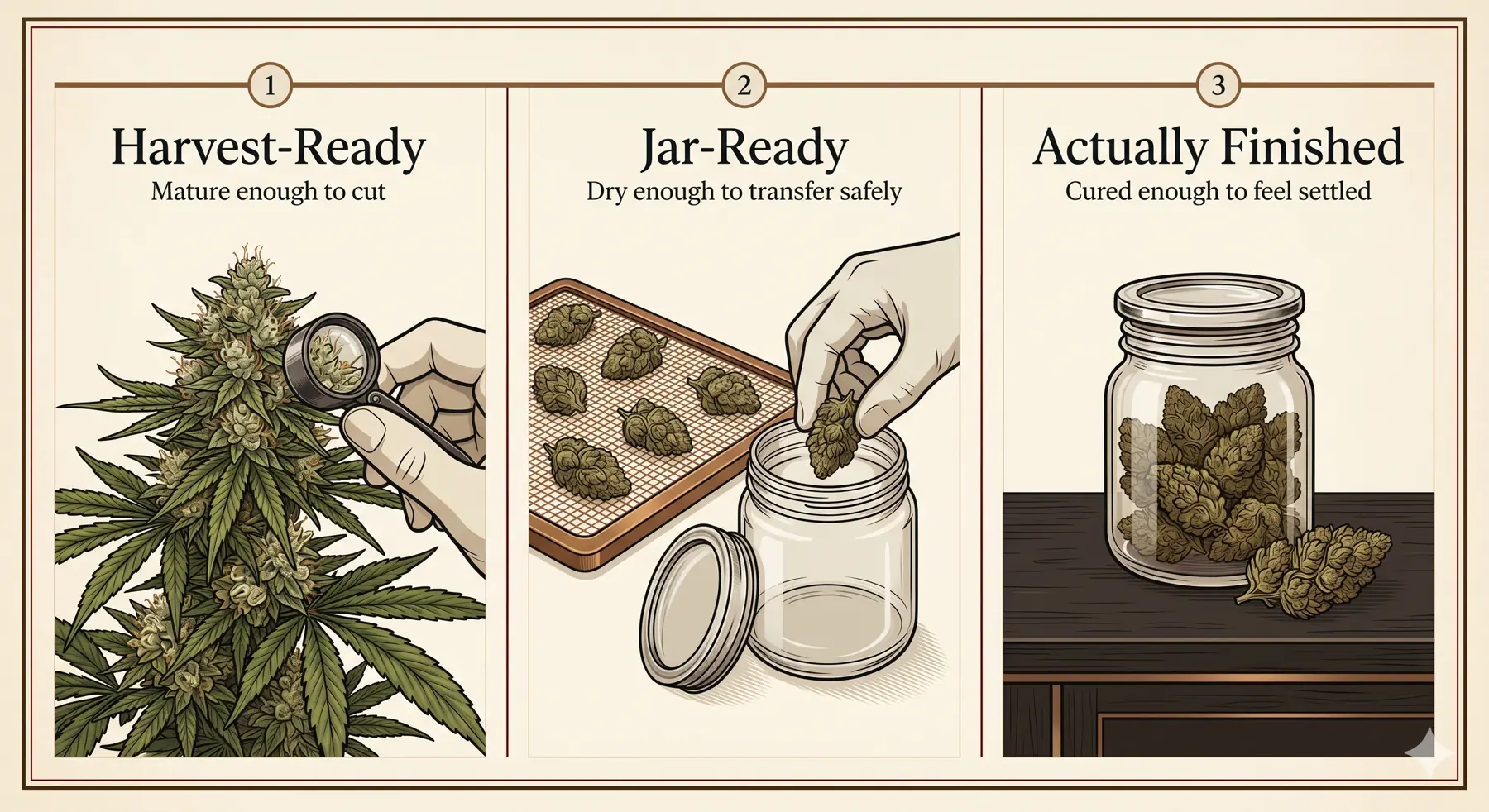
The timeline gets much easier to understand once harvest-ready, jar-ready, and actually finished stop getting treated like the same moment.

Timeline board showing the difference between harvest-ready, jar-ready, and actually finished cannabis flower.
The milestone map works best when harvest, the move to jars, and a truly settled cure are treated as different moments in the same finishing process.
Cut

Harvest-ready

The plant is mature enough to cut, but the flower still has all of drying and cure ahead of it. This is where most timeline guides stop.

Jar

Jar-ready

The dry has settled enough that the flower can move into jars without turning the cure into a moisture emergency.

Finish

Actually finished

The jar has calmed down, the aroma has cleaned up, and the flower no longer feels like it is still arguing with the process that made it.

Timeline logic

The calendar gets cleaner when the room is contained and the method does not keep creating extra recovery work.

Stage 1 Room readiness

Contain the environment, confirm the tools, and make sure the finish plan exists before the clock starts pretending the grow is already underway.

Stage 2 Early establishment

Let the plant and root zone settle cleanly instead of spending the first weeks recovering from avoidable overreactions.

Stage 3 Maturity to chop

The method determines whether the room moves through a shorter edited run or a longer compact photoperiod path.

Stage 4 Drying and cure

The flower still needs a proper handoff, because a fast chop without a clean finish only creates fake speed.

Seed-to-jar timing

The real compact timeline is clearer when the faster path and the longer path sit next to each other.

Stage Faster compact 12/12 path Longer compact photoperiod path What stretches it
Room readiness Before sprout and non-optional. Before sprout and non-optional. Missing meters, unfinished airflow, weak odor control, no drying plan.
Germination / sprout About 2-7 days. About 2-7 days. Weak seed quality, temperature swings, and early handling mistakes.
Early establishment Often about 1-2 weeks. Often about 1-3 weeks. Cold roots, slow starts, overwatering, overfeeding, or early transplant drama.
Sprout to harvest Often about 9-12 weeks total. Often about 13-18 weeks total. Longer veg ambitions, slow cultivars, environmental drift, crowded canopies, and late harvest confidence.
Drying Usually about 7-14 days. Usually about 7-14 days. Humidity drift, overly aggressive airflow, dense flower, and unstable dry space.
Early cure Often about 2-4 weeks after jarring. Often about 2-4 weeks after jarring. Jarring too wet, constant lid fiddling, or trying to rush the jar into behaving maturely.
Calmer finished jar Often about 4-8+ weeks after jarring. Often about 4-8+ weeks after jarring. Pretending the flower is done because it looks done, not because it has settled.
Real seed-to-jar expectation Often about 13-20+ weeks from sprout if you count the finish honestly. Often about 18-26+ weeks from sprout if you count the finish honestly. Every shortcut that gets paid back in drying, cure, or repeated corrections.

Those are not promises. They are cleaner working ranges for compact growers who want to count the whole run instead of only the flattering part. If you only count to chop, almost every grow looks faster than it really was.

Why compact can be faster

A compact run saves time when the room stays legible and the method stays in scale with the enclosure.

Smaller rooms can finish sooner because they invite smaller, cleaner decisions. The plant usually stays shorter. The footprint discourages endless veg fantasies. A contained cabinet or compact enclosure makes airflow, light distance, and root-zone response easier to track. That does not eliminate mistakes, but it does reduce how many weeks get spent pretending the setup can still carry a much bigger plan.

That is why ColaXpress keeps pairing compact spaces with methods like 12/12 from seed, tighter daily reads, and a finish plan that already exists before harvest arrives. The time savings are not magical. They come from fewer detours.

The flagship version of that lives on the VGrow DWC guide. A contained cabinet, a direct root-zone method, a compact flowering rhythm, and a finish chain that already exists together create the kind of calendar that stays edited instead of sprawling.

Why people still lose time

The room feels slow when the grower keeps rebuilding the run inside it instead of letting it move cleanly.

  • Choosing a smaller room, then demanding a larger-room plant out of it anyway.
  • Vegging too long because the grower still wants size to prove the run was serious.
  • Letting environmental drift turn routine weeks into repeated recovery work.
  • Waiting too long to trust the loupe, then cutting because the room feels crowded instead of because the flower is mature.
  • Drying too fast, jarring too early, or treating cure patience like avoidable extra time.

The time loss is usually not one dramatic mistake. It is a string of smaller ones: a cabinet that never quite stabilizes, a plant that was vegged past the footprint, a harvest call made from fatigue, or a jar handoff that happens before the moisture actually settles. Compact rooms do not necessarily punish those choices harder than larger rooms. They simply make the wasted weeks easier to count.

Faster compact path

12/12 from seed is usually the cleaner answer when the room wants a quicker, more edited run.

In a compact room, 12/12 from seed often gives the clearest short timeline because it keeps structure smaller and reduces how much calendar gets spent on vegetative ambition. That is why this path often lands around the nine-to-twelve-week harvest window from sprout before dry and cure are counted.

It is not automatically better. It is simply a stronger fit when the goal is a readable cabinet run with less training pressure and a finish plan that can stay visible. The method page at 12/12 from seed explains where that trade really lives.

Longer compact path

A longer compact photoperiod run can still be right when the room and the grower both have a reason to carry more time.

Some cultivars, structures, and grower preferences still justify the longer path. A compact photoperiod run with more veg often lands closer to thirteen-to-eighteen weeks to harvest before dry and cure are counted. That is not a failure. It only becomes waste when the extra time is spent feeding ego instead of improving the result.

The honest question is whether the room is still getting clearer as the calendar grows, or whether the grow is simply asking the enclosure to keep absorbing more contradiction. Compact craft gets stronger when longer time still produces better clarity, not when it only produces more theater.

Where the timeline gets misread

Most growers do not misread the calendar because they are lazy. They misread it because the flattering milestones arrive before the truthful ones do.

Chop

Counting only to cut

The plant coming down feels like a finish line, but it only closes the grow-side calendar. The finish-side calendar is still waiting.

Jar

Pretending cure does not count

A jar that still feels loud, grassy, or unstable is not finished flower just because it finally left the drying rack.

Room

Confusing smaller with faster

Compact only saves time when the room is prepared, the method fits, and the grower is not rebuilding the plan every week.

This is where compact craft starts separating itself from compact chaos. A cleaner room does not shorten biology. It shortens denial. Once the setup stops wasting weeks on oversized structure, preventable drift, and a rushed finish, the whole calendar feels more honest.

Who should choose the faster path

The shorter compact path makes the most sense for growers who want an edited run and are willing to protect the finish.

  • Readers who value cleaner room logic over larger plant ambition.
  • Cabinet growers who want the calendar to stay tight and interpretable.
  • Anyone willing to count drying and cure as part of the real timeline.
  • Growers building around the flagship contained workflow on the VGrow DWC guide.
Who should accept the longer path

The longer compact path is better when more time is still buying real structure, not just the feeling of doing more.

  • Growers with a clear reason to carry more veg and more shaping inside the same footprint.
  • Readers who know the room can stay readable even as the calendar stretches.
  • Anyone willing to pay for the extra time with more finish discipline, not less.
  • Growers who would rather be deliberate for longer than rushed for less time.
The real answer

The grow is not finished when the plant is cut. It is finished when the flower stops arguing with the process that made it.