Craft cultivation

Craft cannabis cultivation begins when clarity matters more than bulk.

Craft cannabis cultivation is not just smaller-scale cannabis growing. It is a cultivation discipline built around readable methods, cleaner decisions, and a finish worth protecting. The room, the plant, the harvest call, and the cure all have to agree.

Craft starts when the grower stops asking how much this room can carry and starts asking how clearly it can speak. That question changes everything from method choice to the way the jar is read weeks later.

What craft means Readable systems, smaller decisions, and quality that survives all the way to the jar.
What it rejects Max-weight logic, sprawling methods, and a finish-stage plan built from last-minute hope.
Where it shows In the room, in the method, in the harvest call, and in the way drying and cure are treated.
Definition

Craft cultivation is a way of building the run, not a label applied after the flower looks good enough to photograph.

In practical terms, craft cultivation means the grower chooses a setup and method that can still be read honestly when the plant begins answering back. It means feeding with restraint, training with purpose, harvesting by actual maturity instead of calendar fatigue, and treating drying and cure as part of the grow rather than as the sleepy epilogue to it.

That is why ColaXpress keeps returning to readable systems. A craft result is not created by one glamorous decision in week nine. It is created when every stage avoids forcing the next stage to lie on its behalf.
Field note

Craft is not a vibe. It is the discipline of making fewer, clearer mistakes on purpose.

  • Readable room
  • Readable method
  • Readable finish
The four-stage logic

Craft cultivation reveals itself when the room, method, harvest, and finish all stay legible.

Stage 1 Readable room

The enclosure, airflow, odor, and general environment stay stable enough that the plant can speak without static.

Stage 2 Readable method

The method fits the room instead of trying to overpower it, which is why smaller craft systems often beat max-weight ambition in compact spaces.

Stage 3 Readable harvest

The cut is made because the flower is mature under inspection, not because patience expired or the top cola finally looked cinematic.

Stage 4 Readable finish

Drying and curing are calm enough that aroma, texture, and smoke quality can settle instead of being forced through rescue work.

Craft vs max weight

The real contrast is not small versus big. It is clarity versus strain.

Max-weight methods often ask the room to carry more plant, more veg time, more training, more correction, and more late-stage stress. Sometimes that is appropriate. But in compact growing, that logic often pushes the system past the point where the signals stay trustworthy. The grow may still succeed, but it becomes louder, harder to read, and easier to mismanage.

Craft-first cultivation moves in the other direction. It chooses structure that can be held cleanly, method that respects the footprint, and harvest and cure decisions that keep the finish from paying for earlier excess. The plant is not being asked to win a weight contest inside a room that would rather be understood.

Why compact can help

A compact system can support craft unusually well when the grower stops trying to make it impersonate a larger room.

Smaller environments are brutal about contradiction. That is exactly why they can become excellent craft rooms. When the setup is contained, the method is disciplined, and the finish plan exists early, the whole run becomes easier to interpret. The noise floor drops. The grower stops making oversized corrections. The flower arrives at harvest with less damage already hidden inside the process.

This is the logic behind the ColaXpress flagship path in the grow system page. The cabinet, the DWC root zone, the compact method, and the finish chain are all chosen because they reinforce readability. Readers who want the room-size-specific version of that argument should go next to compact craft cannabis grow.

Comparison

The difference becomes easier to trust when it is stated plainly.

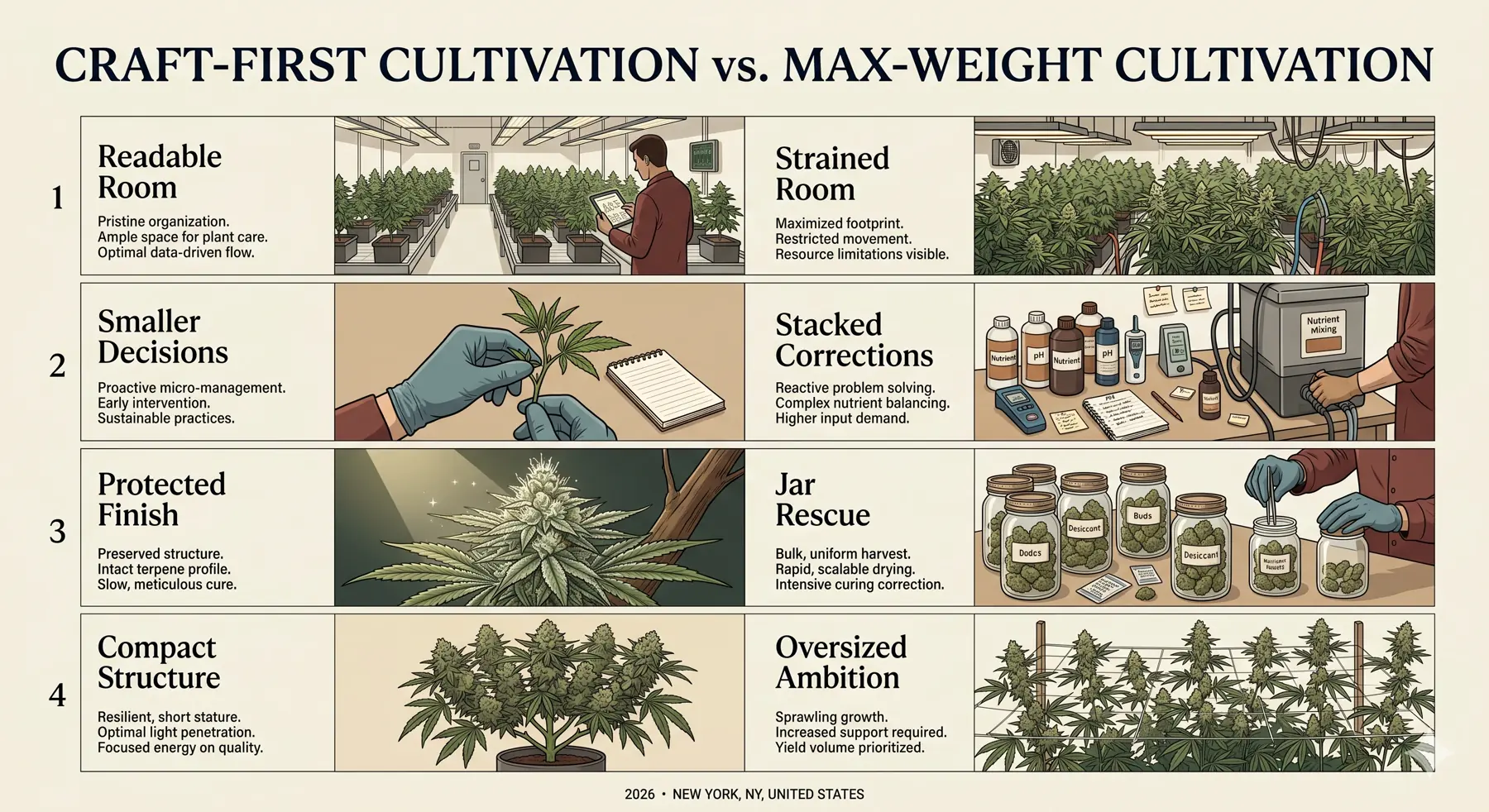
Comparison board showing craft-first cultivation versus max-weight cultivation across room clarity, decision style, finish posture, and plant structure.
The contrast gets easier to trust when room logic, decision style, finish posture, and plant structure are put side by side.
Category Craft-first cultivation Max-weight cultivation
Room logic Build around a space that can stay readable and repeatable. Push the room to carry more plant mass and more contradiction.
Plant structure Smaller, cleaner structure that fits the footprint honestly. Larger structure that often asks for more training, more recovery, and more denial.
Feeding posture Restraint, observation, and fewer stacked corrections. More temptation to chase speed and size with heavier intervention.
Harvest decision Cut based on trichome and canopy maturity together. More risk of harvesting according to schedule pressure or room fatigue.
Drying and cure Protected as part of the grow from day one. Often treated as what happens after the "real" work is over.
Success looks like Finished flower with clarity, aroma, and composure. Impressive biomass that may still ask the jar to rescue the process.

Readers who want the broader market-facing comparison should go next to craft cannabis vs commercial cannabis. This page stays focused on what the cultivation side of that difference actually demands.

What the market calls craft

On shelves, craft often gets reduced to boutique signals that sound good but explain very little.

In retail language, craft often gets collapsed into words like small batch, hand-trimmed, premium, local, terpene-rich, or limited release. Some of those qualities may point toward careful growing. None of them prove it. They describe appearance, scale, or positioning much more easily than they describe cultivation discipline.

That is why the term drifts so easily. The market uses craft as a quality mood. Growers have to decide whether it means anything structural. The broader head-term version of that argument lives on what craft cannabis means. This page stays on the cultivation side of the line.

What cultivation requires

For growers, craft only becomes real when the room, method, and finish can all survive scrutiny.

  • The environment stays readable enough that the plant is not speaking through static.
  • The method fits the footprint instead of turning every week into recovery work.
  • The harvest call is made by maturity, not by calendar fatigue or room pressure.
  • Drying and cure are protected early enough that the jar is not being asked to rescue the run.

That is the divide ColaXpress is trying to make unmistakable. The market can call almost anything craft. Cultivation has to prove it.

Where craft shows itself

The philosophy becomes visible at the method, harvest, and cure stages.

Method

It chooses readable structure

Craft shows itself when the method fits the room, the room stays calm, and the plant does not need theatrical correction to remain manageable.

Read the 12/12 guide
Harvest

It cuts by maturity, not relief

Craft is patient enough to let the flower finish honestly and precise enough to inspect the bud instead of reading wishful surface clues.

Read the harvest guide
Cure

It protects the finish

Craft does not disappear once the branch comes down. It is still present in the handoff to drying, the move to jars, and the discipline of the cure.

Read the cure guide
How the flagship path expresses craft

The VGrow plus DWC path matters here because it makes craft decisions easier to hold onto under pressure.

A compact cabinet, a direct root zone, and a disciplined flowering rhythm do not automatically create a craft result. What they do create is a room where the signals stay cleaner. That matters because craft cultivation is easier to protect when the grower is not being baited into constant interpretation errors by a setup that has already drifted beyond honest control.

This is where the flagship path earns its place. The cabinet contains the environment. The DWC root zone answers quickly. The method keeps structure smaller and more readable. The finish pages exist early enough that harvest and cure are never treated like postscript decisions. That stack does not guarantee skill. It does give skill a clearer place to operate. The product-specific version of that logic lives on the Vivosun VGrow DWC guide, where the hardware gets translated into fit, workflow, and likely failure points.

Where the proof finally lives

The finish is where craft stops being philosophy and starts becoming visible.

Anyone can talk about quality in veg. The harder proof arrives later, when the flower is mature, the trichomes are being read honestly, the dry is controlled, and the cure becomes quieter instead of louder. That is why ColaXpress keeps treating finish quality as part of cultivation itself. A craft grow that collapses in the last ten percent was never as finished as it sounded.

Who this fits

This philosophy fits growers who want flower they can respect more than a room they can brag about.

  • Growers who would rather understand a compact system deeply than force it into a big-room imitation.
  • Readers who care about trichome timing, drying, and cure as much as veg performance.
  • People willing to trade some raw size for clearer signals and better finish quality.
  • Anyone drawn to the idea of craft because they mean process, not packaging.
Who should not force it

This is a weaker fit for growers who still need the room to prove something bigger than the flower.

  • Anyone chasing the biggest possible plant inside a space that is asking for discipline instead.
  • Growers who enjoy sprawling training-heavy systems more than readable compact ones.
  • Readers who want craft as a word of approval without accepting the patience it demands.
  • Anyone who treats post-harvest like paperwork to finish after the exciting part is done.
What craft is not

Craft is not just expensive flower, a slower pace, or a nicer story printed on the jar.

The term gets flattened all the time. It gets used to mean boutique. It gets used to mean hand-trimmed. It gets used to mean not corporate. Some of that may point in the right direction, but none of it is enough on its own. Craft cultivation is a process identity before it is ever a market identity.

If the room is chaotic, the method is oversized, the harvest is rushed, and the cure is improvised, the flower is not made craft by better branding afterward. The process has already spoken.

ColaXpress view

Craft survives because each stage refuses to dump its dishonesty into the next one.

That is why ColaXpress keeps emphasizing system fit, method restraint, and finish discipline. A compact craft run is not impressive because it is small. It is impressive because it stays honest.