Should You Trim Wet or Dry Cannabis at Harvest?
Should you trim wet or dry cannabis? Compare airflow, labor, humidity, and trichome handling to choose a clean harvest workflow for small indoor grows.
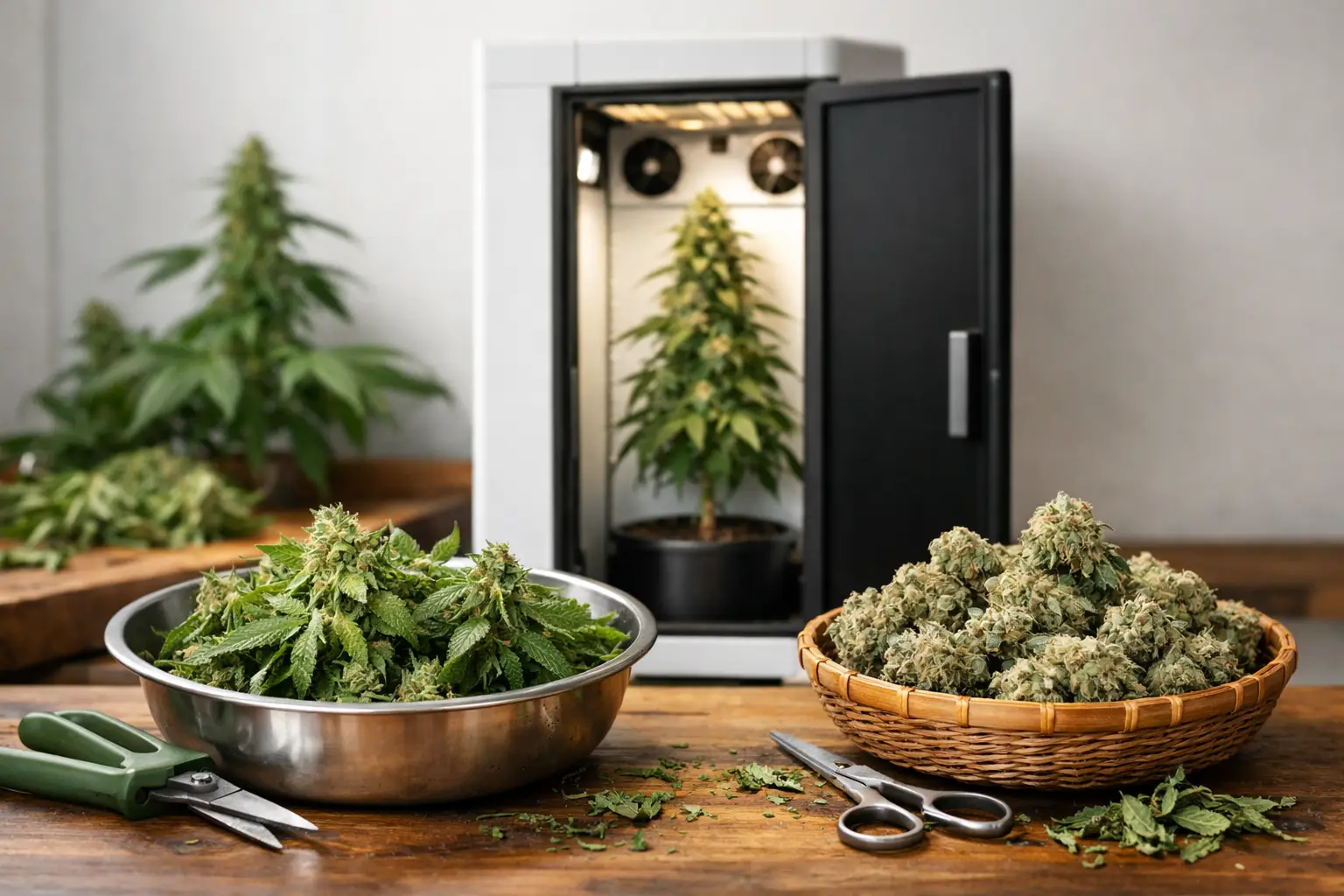
Harvest is where a clean indoor run can get careless fast. Whether you trim wet or dry cannabis affects drying speed, mold risk, labor, and the condition of the flower when it reaches the jar. There is no universal winner. There is, however, a better choice for the conditions you actually control.
For compact cabinet, tent, and small-room growers, dry trimming is usually the stronger default. It slows the finish, protects against rushed handling, and gives you more room to read the dry rather than forcing the plant through it. Wet trimming still has a place, but it should solve a real environmental or workflow problem, not just satisfy the urge to make harvest look tidy on day one.
Trim Wet or Dry Cannabis: The Practical Answer
Wet trimming means removing most fan leaves and sugar leaves immediately after cutting the plant. The flower then dries without much leaf material around it. Dry trimming means hanging branches or whole plants with much of the leaf intact, drying them first, then trimming the crisp outer leaf once the flowers have reached the right moisture level.
The central trade-off is simple. Wet trimming creates a faster, cleaner-looking harvest day, but it can make flowers dry too quickly. Dry trimming takes more patience and creates a messier trim session later, but it generally supports a slower, more forgiving dry.
That matters in small spaces. A VGrow cabinet or compact tent does not have the environmental buffer of a dedicated drying room. Air volume is limited. Fans can be too aggressive. Heat from equipment can linger. In that environment, the leaves left on a drying plant are not just cosmetic. They provide a modest buffer against the flower shedding moisture too fast.
If your dry space runs warm, dry, or has active airflow you cannot fully redirect, dry trimming is usually the safer move. If your drying environment stays damp and stagnant, wet trimming may help you avoid creating dense pockets of trapped moisture. The right choice follows your room conditions, not a rule from social media.
What Wet Trimming Changes
Wet trimming is physically easier. Fresh leaves stand away from the buds, stems are flexible, and scissors move quickly. For a small harvest, this can feel efficient. You can remove fan leaves, shape the buds, and hang neat branches without returning to a pile of dry material several days later.
It can also be useful when the plant is exceptionally leafy or when your drying space has stubbornly high humidity and limited air exchange. Removing excess leaf mass reduces the amount of water entering that space. That can make a meaningful difference if you are drying in a crowded enclosure.
The downside is speed. Once you strip away the leaves, more of the flower surface is exposed. In dry conditions, the outside of the buds can become crisp while the center still holds moisture. That creates the classic false finish: flowers feel dry enough to jar, then redistribute moisture in the jar and become too wet.
Wet trimming also demands a long, sticky harvest session. Fresh resin clings to gloves, scissors, trays, and every leaf edge. The more you handle flowers while they are wet, the more chances you have to knock off trichomes, compress delicate buds, or simply get tired and start cutting too close.
Wet trim is not wrong. It is a tool for growers who need to reduce drying load or who have a reliably cool, moderately humid space that will not strip moisture from exposed flowers. It is less forgiving when the dry environment is already working against you.
What Dry Trimming Changes
Dry trimming extends the drying process because the remaining leaves slow moisture loss. For quality-focused home growers, that is often the point. A slower dry gives internal moisture more time to move outward gradually, which usually produces a smoother, more even finish than flowers rushed dry in a few days.
Dry trimming also separates harvest into two jobs. On chop day, you remove only the large fan leaves that have no resin value, cut branches to a manageable size, label cultivars, and get the crop hanging. That is it. You protect the environment first instead of turning harvest into an all-night grooming project.
After the branches are dry enough to trim, the sugar leaves have curled around the buds. They are less convenient to remove, and trimming can take longer. A trim bin, sharp scissors, and a clean work surface matter more here. But dry leaves often break away cleanly, and you can make better decisions about final bud shape when the flower is no longer soft and swollen with water.
The real risk with dry trimming is not the trim itself. It is leaving the plant too dense in a poor drying environment. Whole plants hung tightly together in a humid cabinet can trap moisture between branches. That is not a craft approach. It is avoidable drama.
For compact grows, dry trim works best when branches have space between them, air moves gently through the area rather than directly at the flowers, and you can keep checking conditions without constantly opening the drying space.
Choose Based on Your Drying Conditions
Start with the space, not the plant. If you can hold a cool, stable environment with moderate humidity and gentle air exchange, leave more leaf on and dry trim. You have the conditions needed for a controlled finish.
If humidity stays elevated, the enclosure is crowded, or moisture lingers on dense flower sites, remove more leaf before hanging. You do not need to turn every bud into a fully manicured product on harvest day. A practical middle path is often best: remove fan leaves and the largest non-resinous leaves, then leave the sugar leaf for the dry trim. This reduces drying load without exposing every calyx.
Pay attention to flower density as well. Tight, heavy buds hold moisture longer than airy flowers. A dense cultivar in a compact drying area deserves more branch spacing and more caution than a loose, open-structured plant. The plant tells you how much drying margin you need.
Do not use trimming to compensate for a broken environment. If the room is hot, fix temperature. If humidity is swinging wildly, stabilize it. If a fan is blowing directly at the crop, redirect it. Trimming is not a substitute for environmental control.
A Disciplined Dry-Trim Workflow
For most small indoor growers, keep harvest day narrow and controlled. Cut plants or branches during a calm work window, remove large fan leaves, and inspect every branch before it enters the dry space. Look closely where dense buds meet stems. Any damaged, dying, or questionable material should be separated immediately rather than hung with clean flower.
Hang branches with enough room that they do not press together. Do not pack a cabinet because the harvest looks smaller than expected on the cutting table. Once the door closes, moisture has nowhere useful to go. Keep airflow indirect and gentle. You are exchanging air, not trying to blow-dry buds.
As drying progresses, use the small stems as one signal, not the only signal. When smaller stems begin to bend with a slight snap rather than folding like green wire, inspect the flowers. They should feel dry on the outside but still retain a little give deeper in the bud. If they are brittle throughout, the dry went too far. If they feel wet, cool, or soft at the center, they need more time.
Trim in small batches once the flowers are ready. Work over a clean tray, make deliberate cuts, and avoid over-manicuring. Sugar leaves with visible resin are not a quality failure. A flower does not need to look machine-perfect to smoke cleanly. Preserve the structure, remove what interferes with the finish, and keep the usable trim for a separate purpose.
When Wet Trimming Is the Better Call
Choose wet trimming when your drying area has persistently high humidity, when a very leafy plant would overload a small enclosure, or when you have a large enough harvest that untrimmed branches cannot be spaced safely. In those situations, reducing leaf mass can be the disciplined choice.
If you wet trim, compensate for the faster dry. Hang whole branches instead of loose individual buds whenever possible. Keep airflow especially gentle, check the crop more often, and do not let a crisp surface convince you the center is ready for jars. Your goal is still a gradual, even dry. You have simply removed part of the plant's natural buffer.
Avoid wet trimming just because you want the work finished immediately. Harvest is not a race to the jar. The cure cannot repair a dry that was rushed, overheated, or uneven.
The Errors That Ruin Both Methods
The biggest mistake is treating trim style as the main quality lever. It is not. Temperature, humidity, branch spacing, air exchange, and patience carry more weight than whether you removed sugar leaves on day one or day ten.
The next mistake is overhandling. Every extra squeeze, aggressive turn, and repeated inspection damages the presentation of the flower. Handle branches by the stem. Let the buds stay buds.
Finally, do not confuse a tidy appearance with a finished product. A heavily wet-trimmed flower can still be too moist inside. A shaggy dry-trimmed branch can still dry too fast. Read the moisture, then move to the next stage.
Choose the trim method that gives your drying environment the most control. In a compact grow, that usually means leaving enough leaf to slow the process, giving branches room, and letting patience do the work that extra gear and frantic trimming never will.