Seed to Jar Cannabis Workflow That Holds Up
A practical seed to jar cannabis workflow for compact indoor grows, from setup and root zone control to harvest, drying, and cure discipline.
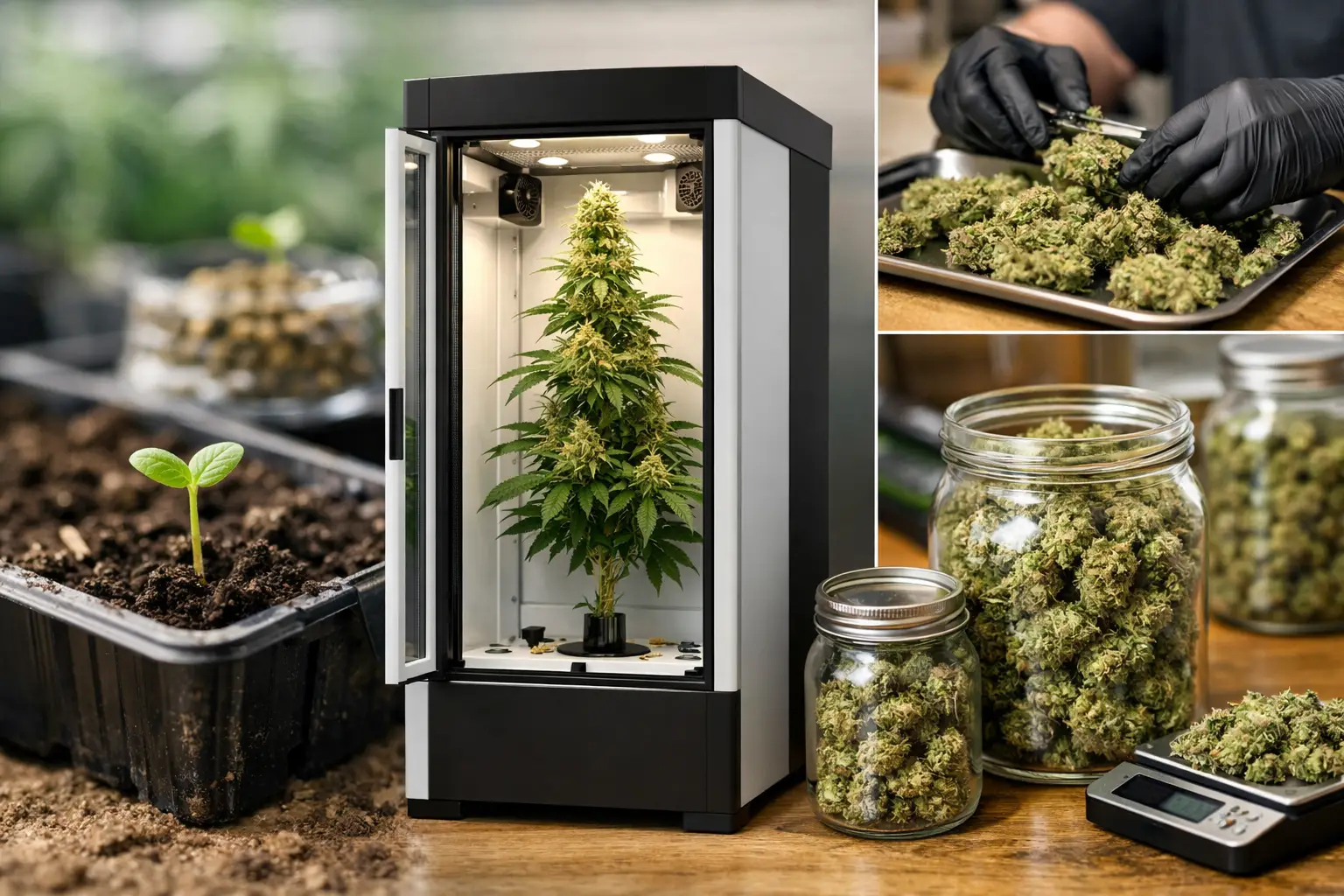
Most home grows do not fail because the plant is hard to grow. They fail because the workflow is sloppy. A solid seed to jar cannabis workflow gives each stage a job, keeps your environment readable, and prevents one early mistake from snowballing into weak flower, bad dry conditions, or a cure that never recovers.
That matters even more in compact indoor spaces. In a cabinet, small tent, or corner grow, you do not have much room for recovery. Heat stacks faster. Humidity swings harder. Stretch gets out of hand sooner. If your method does not match your space, the grow starts managing you instead of the other way around.
What a seed to jar cannabis workflow actually means
This is not just a timeline from germination to harvest. A true seed to jar cannabis workflow is a controlled sequence where your enclosure, grow method, plant size, and finish process all fit together. You are not trying to squeeze random forum advice into a small environment. You are building a repeatable system.
For most beginners, that means making a few disciplined choices early. Pick a space you can control. Pick a method you can actually read. Pick a plant strategy that fits the enclosure. Then protect the finish stage with the same seriousness you gave the grow.
A lot of growers get the first half mostly right and still end up disappointed. They chase decent structure and healthy leaves, then rush harvest, overdry the flower, or jar it too wet. Good flower is grown all the way through the cure. That is the standard.
Start with method-to-space alignment
Before you think about nutrients, genetics, or training, ask a simpler question: what kind of plant can your space finish cleanly? In compact grows, this question decides almost everything.
If you are working in a cabinet or short tent, oversized veg plans usually create avoidable problems. Long vegetative periods can turn a manageable plant into a humidity trap with poor airflow and crowded bud sites. That is why a disciplined small-space workflow often favors a faster flowering strategy such as 12/12 from seed or a very short veg window. You are trading raw size for environmental control, cleaner structure, and a finish you can actually manage.
This is also where growers overbuy gear. More equipment does not fix a mismatched plan. If your enclosure is small, the win is not adding more gadgets. The win is choosing a workflow that keeps the canopy proportionate, the root zone stable, and the dry stage protected.
Germination and early establishment
The first stage is about clean starts, not speed. Germinate the seed with a simple method you can monitor, then move into the final system without unnecessary transplant stress if your setup allows it. In deep water culture, early root establishment matters more than impatient top growth. You want a seedling that is upright, responsive, and not fighting excess moisture or weak environmental control.
At this stage, beginners often make two mistakes. First, they feed too aggressively before the plant has earned it. Second, they misread slow early growth as a reason to intervene constantly. Young plants need stable conditions more than heroic adjustments.
Keep the environment calm. Keep light intensity appropriate. Keep the root-zone plan simple and clean. If the seedling is healthy, the goal is not to force growth. The goal is to build a plant that transitions into active development without stress stacking from day one.
Vegetative growth in a compact system
In a small enclosure, veg is not the place to prove ambition. It is the place to build a plant you can still control in flower. That means reading structure honestly. If internode spacing is getting loose, your environment and light positioning need attention. If leaves look heavy or dull, your root zone may be sending a warning before the canopy shows major damage.
This is one reason DWC appeals to growers who want a readable system. When the root zone is managed well, the plant usually tells the truth quickly. You can see response, vigor, and stress signals without guessing through a large soil buffer. The trade-off is that mistakes also show up fast. Water temperature, oxygenation, and solution balance matter. DWC is not forgiving of neglect, but it is highly teachable when approached with discipline.
For compact growers, simpler structure often beats heavy training. You do not need to turn every plant into a project. A modest, well-spaced canopy with decent airflow is usually better than a crowded one shaped by constant correction. This is where ColaXpress has the right bias: clarity, not chaos. The plant should fit the space without drama.
Flowering is where workflow pays off
Once you flip to flower, your margin for sloppiness shrinks. Stretch changes the geometry of the space. Transpiration changes the humidity load. Feeding strategy often needs adjustment. If the workflow was weak earlier, flower exposes it.
This is why small-space growers benefit from a flower-first mindset even before the flip. You should already know how much vertical room remains, how your environment behaves when biomass increases, and whether your exhaust and circulation are enough for the finish. If you are asking those questions midway through stretch, you are late.
A clean flowering phase depends on restraint. Do not keep making structural changes after the plant has committed to flower unless there is a clear reason. Do not overfeed in hopes of bigger buds. Do not ignore warning signs because the plant still looks mostly green. Read the plant, but read the room too. In compact spaces, the environment is often the real issue.
Harvest timing is part of the workflow, not an event
Harvest is where impatient growers throw away weeks of good work. The plant is not done because you are tired of waiting. It is done when the flower has reached the balance of maturity you actually want.
That means using more than one signal. Trichome development matters, but so do pistil progression, calyx swelling, and overall plant fade relative to the cultivar and growing conditions. Harvesting early often protects anxiety, not quality. Chopping too late can flatten the effect and dull the flower. There is no magic universal day count. It depends on the plant, the environment, and your target result.
The other common mistake is treating harvest day like a scramble. Your drying space should already be ready. Temperature and humidity targets should already be stable. If you are trimming while trying to figure out where the branches will hang, your workflow has already broken.
Drying is where craft growers separate themselves
A lot of average homegrown was grown reasonably well and dried badly. Fast drying strips quality. Hot, dry air pushes terpenes out and leaves the outside of the flower feeling finished while the inside is still uneven. Then the jar gets blamed for what the dry stage ruined.
In a disciplined seed to jar cannabis workflow, drying gets the same respect as feeding and environmental control during flower. The room should be dark. Air should move, but not blast the hanging plant. Conditions should stay in a range that slows the process enough to protect aroma and texture without inviting mold.
This is also where compact growers need to think ahead. If your grow space doubles as your drying space, plan for that before harvest. Do not assume the same settings that worked for flower will automatically suit the dry. They usually will not.
Curing turns decent flower into finished flower
The cure is not a waiting room. It is an active final stage where moisture equalizes, chlorophyll harshness continues to fade, and the flower settles into its real expression. If you jar too wet, you risk mold and a stale smell. If you jar too dry, the cure has less room to improve texture and aroma.
This is where discipline beats guesswork. Use feel, smell, and consistent checks during the first days in jars. Burping is not about following a rigid internet schedule. It is about responding to what the flower is doing. Some batches need more attention early. Some were dried so well that the cure starts quietly.
A good cure rewards patience, but it also rewards proper setup before the flower ever entered the jar. You cannot cure your way out of a rushed dry, a sloppy harvest, or a plant that finished under stress.
The real goal is repeatability
The best seed to jar cannabis workflow is not the one that sounds the most advanced. It is the one you can repeat with clean results in your actual space. That usually means fewer moving parts, tighter environmental awareness, and more respect for the finish stage.
If you are growing indoors in a cabinet, small room, or tent, think like a craft operator, not a yield chaser. Build a workflow your space can support. Read the plant without panicking. Protect the dry and cure like they matter as much as the grow itself. The jar tells the truth about every stage before it.