How to Use Vivosun VGrow the Right Way
Learn how to use Vivosun VGrow for a clean first run, with setup, climate, watering, lighting, and harvest tips for compact indoor grows.
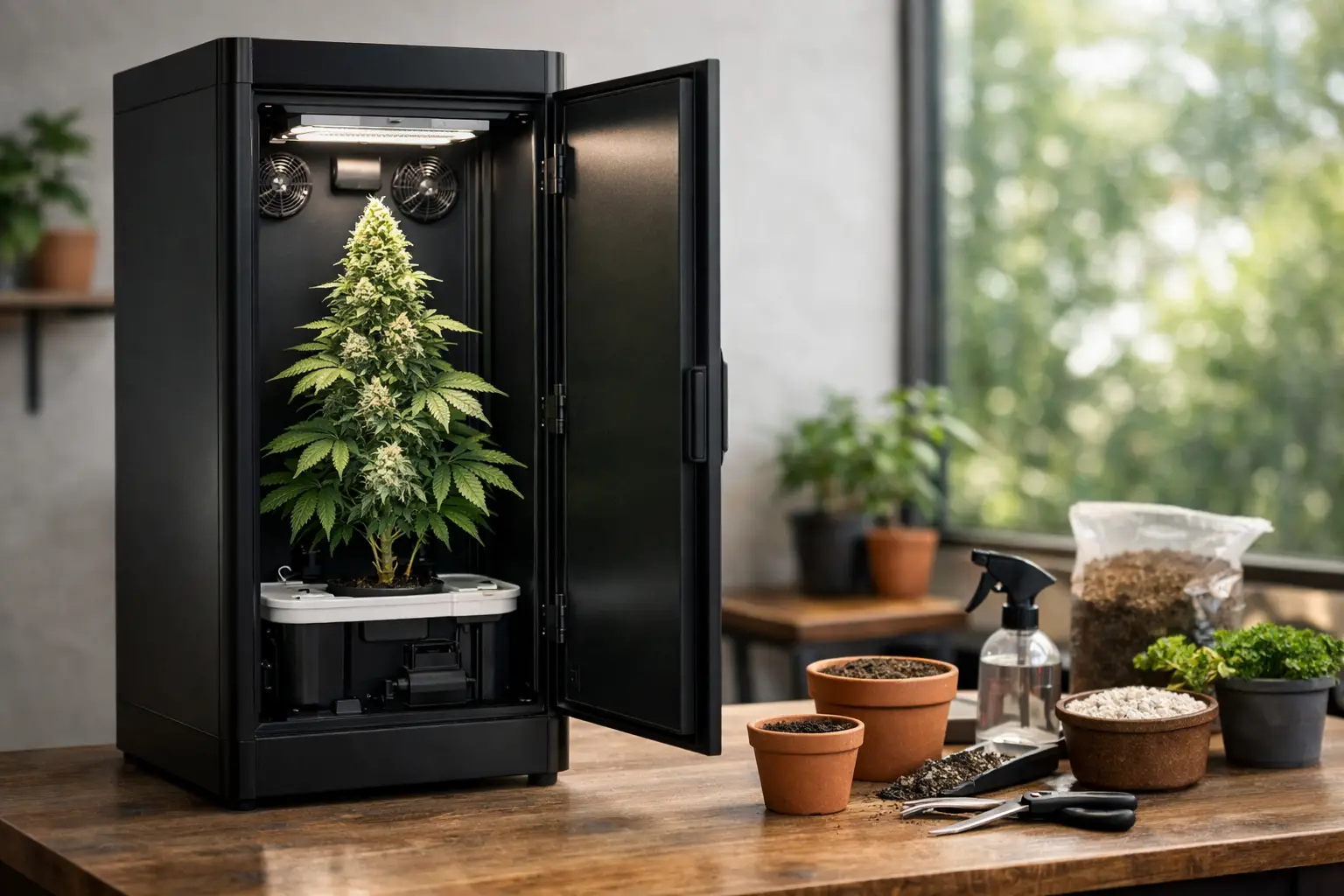
The VGrow is not hard to run. What trips people up is trying to treat it like a full-size tent, then wondering why the cabinet feels crowded, wet, or unstable. If you want to learn how to use Vivosun VGrow well, start with one rule: match your method to the space. In a cabinet this compact, restraint beats ambition every time.
That means one plant, one clear workflow, and fewer moving parts. The VGrow can produce very good flower, but only if you stop chasing big-room habits inside a small enclosure. A clean run comes from environmental control, readable plant structure, and a finish stage you do not fumble.
How to use Vivosun VGrow without creating chaos
The cabinet gives you a controlled shell. It does not save you from bad decisions. If you cram too much plant mass into it, overfeed, overwater, or run the wrong expectations, the system gets noisy fast. Leaves stack up, humidity spikes, airflow gets blocked, and small mistakes compound.
So the smart way to use the VGrow is to simplify the grow before it starts. Run one cultivar. Avoid long veg. Keep the canopy modest. Let the cabinet do what it is good at - containing a compact, disciplined grow with stable conditions.
For most beginners, that means rejecting the max-yield mindset. This is not the place to chase monster plants, heavy training, or a dozen bottled additives. Craft beats clutter here.
Start with a method that fits the cabinet
Before you germinate anything, choose the grow style. This is where most of the later problems are born.
If your goal is a smoother first run, use a simple plant count and a short lifecycle. In a compact cabinet, long vegetative growth creates more trouble than value. Bigger plants need more pruning, more support, more root-zone management, and tighter climate control. They also leave less margin for error once flower starts.
A disciplined 12/12 from seed approach makes a lot of sense in the VGrow because it keeps size under control. You are not trying to build a huge frame and then force it to fit. You are growing to the cabinet instead of against it. If you prefer a short veg, keep it short for real, not in theory. A few extra days can matter more in a cabinet than they do in a tent.
Medium choice matters too. If you are experienced with deep water culture and know how to manage water temperature, root health, and solution strength, hydro can work very well in a compact enclosure. But if you are new and mainly want a readable first harvest, simpler irrigation often wins. The cabinet itself is not the challenge. Root-zone management is.
That is the trade-off. Hydro can grow fast, but it also punishes inattention faster. In small-space growing, speed is only useful if you can stay ahead of the system.
Set up the cabinet before the plant goes in
A rushed setup usually becomes a troubleshooting session two weeks later. Build the environment first.
Make sure the cabinet is clean, level, and placed somewhere with stable room temperatures. If the room around the cabinet swings hot during the day or cold at night, the cabinet has to fight harder than it should. Small enclosures are reactive. They show room problems quickly.
Check airflow, verify your light schedule, and make sure you understand how the controller behaves before the seedling arrives. You do not want to learn the app or test fan settings while the plant is already stressed.
Pay attention to water handling and runoff management if your setup uses it. In a compact grow, a little spilled water becomes a humidity problem fast. The same goes for dead leaves, loose media, and standing moisture. Clean cabinet, clean workflow.
Dial in the climate like a small-space grower
The VGrow works best when you stop thinking in broad strokes. “Warm enough” and “humid enough” are not good enough in a cabinet. Small spaces reward precision.
During early growth, you want enough humidity to keep the plant comfortable, but not so much that air feels stagnant. As the plant gets larger, your margin shrinks. More leaf mass means more transpiration, which means humidity can rise quickly, especially after watering and right after lights out.
This is where many new growers lose control. They focus on feeding charts and ignore the basic read: if the cabinet feels crowded and damp, flower quality is already at risk. Airflow and leaf management matter just as much as nutrients.
In flower, lower humidity and strong air exchange become more important. Not because lower is always better, but because dense plant material in a small enclosure can trap moisture. Bud rot in a cabinet usually starts with optimism - too much plant, not enough space, and the belief that one more week of bulk is harmless.
It depends on your cultivar, your room, and your irrigation style, but the principle stays the same: keep the climate readable. If the cabinet feels like it is getting away from you, it probably is.
Use the light with discipline, not ego
The light in the VGrow can do its job if you let plant structure stay proportional to the cabinet. If the canopy gets too tall or too uneven, your options narrow. Then you start bending late, stripping too much, or bleaching tops because the plant outgrew the plan.
Keep the canopy even early. Gentle training is fine. Aggressive correction late is usually a sign that the run was not scoped properly.
Watch the plant, not just the setting. If leaves are praying lightly and growth looks steady, you are probably in range. If the top growth looks stressed, pale, twisted, or too tight, back up and read the whole environment before blaming genetics. Light stress in a cabinet is often a combined issue involving canopy distance, leaf temperature, and feeding pressure.
More intensity is not automatically better. In a compact grow, too much light pushes demand across the whole system. The plant drinks harder, nutrient sensitivity increases, humidity behavior changes, and any weak point becomes more obvious. Push only what your environment can support.
Watering and feeding in the VGrow
If you want cleaner results, feed less aggressively than social media tells you to. Most first runs get into trouble from excess, not deficiency.
In soil or coco, avoid the beginner habit of watering on emotion. Water on plant need and pot behavior. A constantly wet root zone inside a compact cabinet creates slow roots, droopy growth, and elevated humidity. None of that helps flower quality.
In hydro, the same principle shows up differently. You are not waiting for pots to dry, but you still need discipline. Monitor water temperature, solution strength, and root condition. If roots look unhappy, do not solve it by pouring in more nutrients. Fix the cause.
The VGrow does not require a fancy feeding program. A simple, stable nutrient plan usually performs better than a shelf full of boosters. Especially in a small cabinet, every input has consequences. Keep the root zone predictable and the plant becomes easier to read.
Prune for airflow, not for internet points
You do need some canopy management in the VGrow. You do not need to turn one small plant into a training experiment.
Remove leaves that clearly block airflow or bury developing sites in wet shade. Clean up weak lower growth that will never become worthwhile flower. Beyond that, be measured. Over-pruning in a compact cabinet can stall growth just as easily as under-pruning can crowd it.
The right amount depends on vigor and structure. An open, cooperative cultivar may need very little. A leafy, dense plant may need steady cleanup. The goal is not a dramatic before-and-after photo. The goal is a cabinet that stays breathable through flower.
Finish stronger than you started
A lot of growers learn how to use Vivosun VGrow well enough to get to harvest, then give away quality in the last two weeks. That is avoidable.
Late flower is where discipline matters most. Keep the environment stable. Do not start improvising with extreme defoliation, wild feed changes, or panic harvesting because a few leaves faded. Read maturity from the whole plant, not one signal.
Once you cut, the cabinet phase is over but the quality test is not. Drying too warm, too fast, or in unstable humidity can flatten terpene expression and make decent flower feel average. If your drying space is weak, fix that before your next run. Growing good flower and finishing good flower are not the same skill.
Curing also rewards restraint. Burping jars obsessively, jostling buds around, or packaging too early creates its own problems. Slow down and let the finish do its work.
The VGrow is best used as a compact, disciplined production space, not a flex machine. Treat it like a system, keep the plant proportional to the cabinet, and make decisions the environment can actually support. That is how you get repeatable flower without turning a small-space grow into avoidable drama.