DWC Water Level: Where the Line Sits at Every Stage
Where should the DWC water level sit? Stage-by-stage waterline targets relative to the net pot, plus what your daily drop rate is telling you.
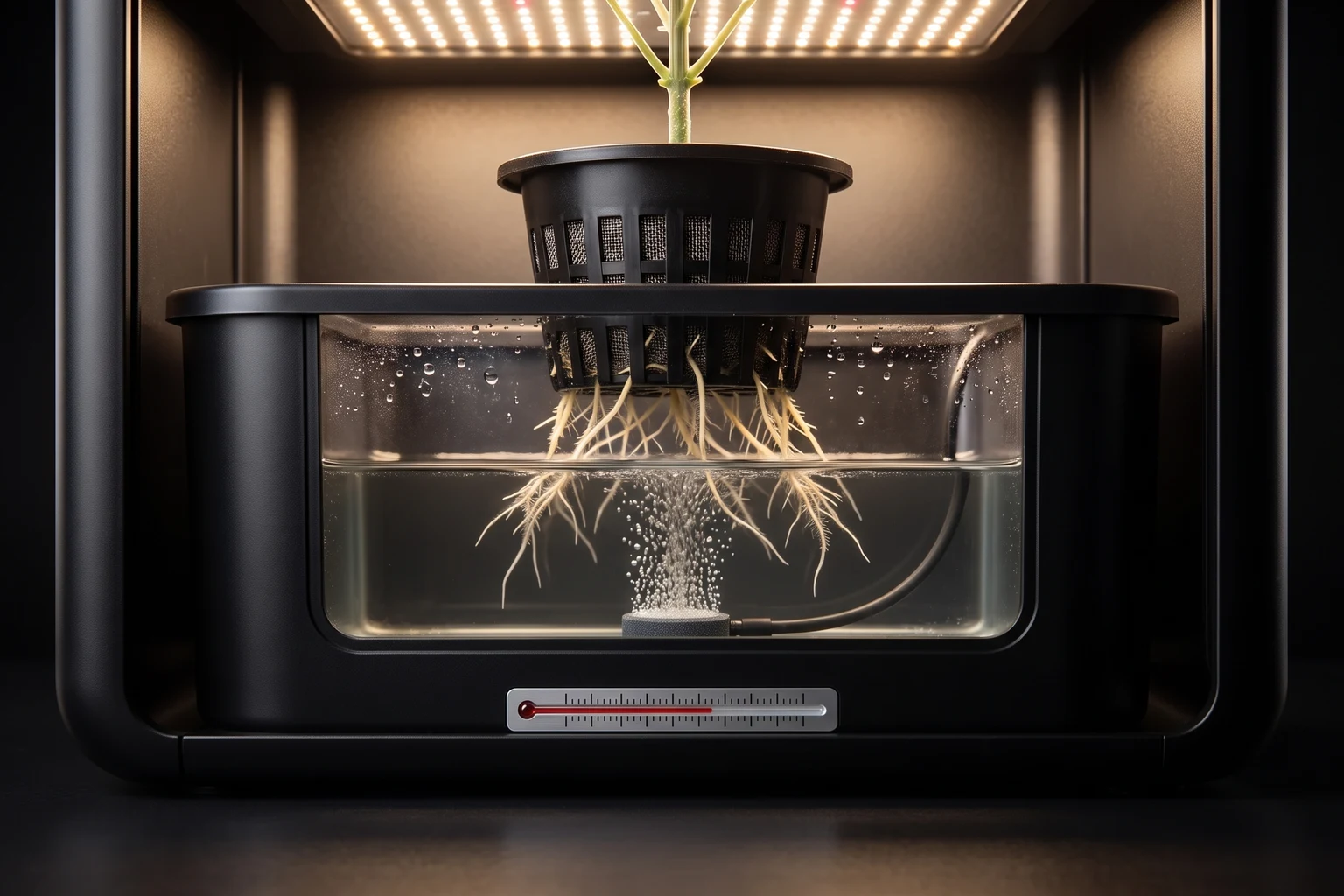
Most DWC guides treat the water level like a chore: keep it topped up, don't let it run dry, move on. That framing misses what the waterline actually is — a control surface. In a bucket or cabinet reservoir, where the line sits relative to the net pot decides whether your roots spend the day drinking or drowning, and how fast it moves is one of the most honest daily reports your plant will ever file. This article gives you the DWC water level targets stage by stage — an established plant runs one to two inches of gap below the net pot — and teaches you to read the drop.
The Two Zones Every DWC Bucket Has
Strip a deep water culture system to its parts and there are only four: a net pot holding the plant, a reservoir of nutrient solution, an air pump pushing bubbles through a stone, and the space between the water surface and the bottom of the net pot. That last part — the air gap — is the one beginners overlook, and it is not empty space. It is a humid, oxygen-rich splash zone where the upper roots breathe.
Submerged roots drink; they take up water and nutrients, along with the oxygen your air stone dissolves into the solution. The roots in the gap do something different: bathed in bubble splash and near-100% humidity, they take in oxygen directly. A healthy established DWC plant uses both zones at once. Fill the reservoir to the brim and you delete the second zone entirely — which is why "fuller is better" is the more dangerous instinct: an empty reservoir announces itself, while a too-full one drowns roots in silence.
Where the DWC Water Level Sits, Stage by Stage
These targets are standard DWC practice rather than laboratory findings — the physiology behind them (oxygen above the line, uptake below it) is solid, but the exact inch marks are craft convention. They work, and they are the ones our own run will use.
Germination to first roots. Until roots actually reach the water, the plant lives on wicking and splash. Set the line so it touches the bottom of the net pot, or sits no more than about half an inch below it, and let the air stone run hard — the bubbles bursting at the surface keep the starter medium moist. If the seedling sits high in a deep net pot, hand-water the medium lightly until roots find their way down.
First roots in the water. The day you see roots trailing through the net pot into the solution, start backing the line off. Target about an inch of gap below the net pot bottom. The root tips stay submerged; the upper roots start learning to breathe.
Established veg through flower. Once a real root mass hangs in the reservoir, hold the line one to two inches below the bottom of the net pot and keep it there for the rest of the run. The upper roots in the gap will look different — fuzzier, lighter — and that is exactly right. From this point on, the net pot bottom should never sit in the water again: a permanently wet crown and stem base is an open invitation to rot at the one point the plant cannot afford it.
If you take one action from this section, make it this: once the plant is established, mark the target line on the outside of the reservoir. A strip of tape turns every future judgment call into a two-second glance. If your reservoir is opaque, give yourself a window: a clear sight tube on a bulkhead fitting, or a marked dipstick through the lid port — either one does what the tape does.
The Drop Rate Is a Daily Report
Now the more valuable half of the subject. A healthy, established plant in a compact system moves the waterline visibly every day — seedlings barely register, while a flowering plant in a small reservoir can pull the line down an inch or more between checks. The number itself varies with plant size, temperature, and humidity. What you read is the pair — level direction against EC direction — and it takes an EC pen to read it. Three patterns cover almost every morning:
Level falls, EC rises. The plant is taking water faster than nutrients — normal in warm rooms, dry air, and late flower. Left alone, the shrinking reservoir concentrates itself and feed strength creeps up without you touching anything. Top off with plain or very low-EC water to bring the line back to target, and let the EC settle back into band.
Level falls, EC falls. The plant is drawing down nutrients faster than water — common in strong vegetative growth. Top off with mixed solution, and if the pattern repeats for days while the plant looks pale or hungry, a modest strength increase is justified. Modest: our stage bands run 0.4–0.8 mS/cm for seedlings up to a 1.5–2.0 peak in flower, and the top of a band is a ceiling, not a goal. (Credible sources put flowering peaks anywhere from ~1.6 to ~2.4 depending on cultivar, system, and irrigation style; DWC typically runs lower, which is why our band does.)
Level barely moves. This is the quiet alarm. An established plant that stops drinking is telling you the root zone is in trouble, and the first suspect is temperature: check that the reservoir sits in the 65–70 °F target band. Warm solution holds less dissolved oxygen — roughly 9.1 mg/L at 68 °F down to 7.6 mg/L at 86 °F — exactly when roots demand more of it, and the pathogen behind classic root rot rides along symptomlessly in cool water and turns destructive in warm. Our reservoir temperature guide covers the fix sequence, and preventing root rot in DWC covers what to do if the smell test already failed.
One habit ties this together: when you check the line each day, glance at it before you top off, at roughly the same time. A drop reading taken after a refill is a measurement of nothing. As for how often to top off: in a compact system, small daily top-offs beat big weekly rescues — the level stays at target and the reading stays honest.
Why the Level Moves Everything Else
The waterline is variable four of the six numbers this site is built around — root-zone oxygen — but it does not move alone. A falling level shrinks the reservoir volume, which makes temperature swing faster and concentrates EC sooner. A topped-off reservoir buffers all three. This is the general shape of DWC: the smaller the water body, the faster every mistake compounds, which is why a compact cabinet demands a steadier hand than a 55-gallon tote ever would. Our guide to running DWC correctly puts the water level inside the full running routine, and the grow system pages hold the rest of the method.
Three Misreadings to Retire
"Keep it as full as possible." Full deletes the air gap. Established roots need the one-to-two-inch breathing zone more than they need the extra half gallon.
"All the roots should be underwater." The fuzzy upper roots in the splash zone are not drying out — they are doing their job. Only a root mass that is visibly desiccating in a too-large gap needs the line raised.
"The level only matters when it's low." By the time the pump gurgles, you have missed a week of information. The daily drop, read against EC, is the point — the low-water emergency is just what happens when nobody was reading.
The Payoff
A reservoir held at the right line, read once a day, gives you a plant whose behavior you can actually interpret — you will know the day the drop rate changes, not the week the leaves complain. That is the difference between running a system and rescuing one.
Monday we take that idea as far as it goes: a twelve-week season built on the six numbers that decide everything in a compact grow — and a live, fully logged run where you can watch every one of them, including this waterline, published as it happens.