DWC Reservoir Temperature Problems and Fixes
DWC reservoir temperature problems can stall growth fast. Learn safe water ranges, warning signs, cooling options, and how to protect roots in grow spaces.
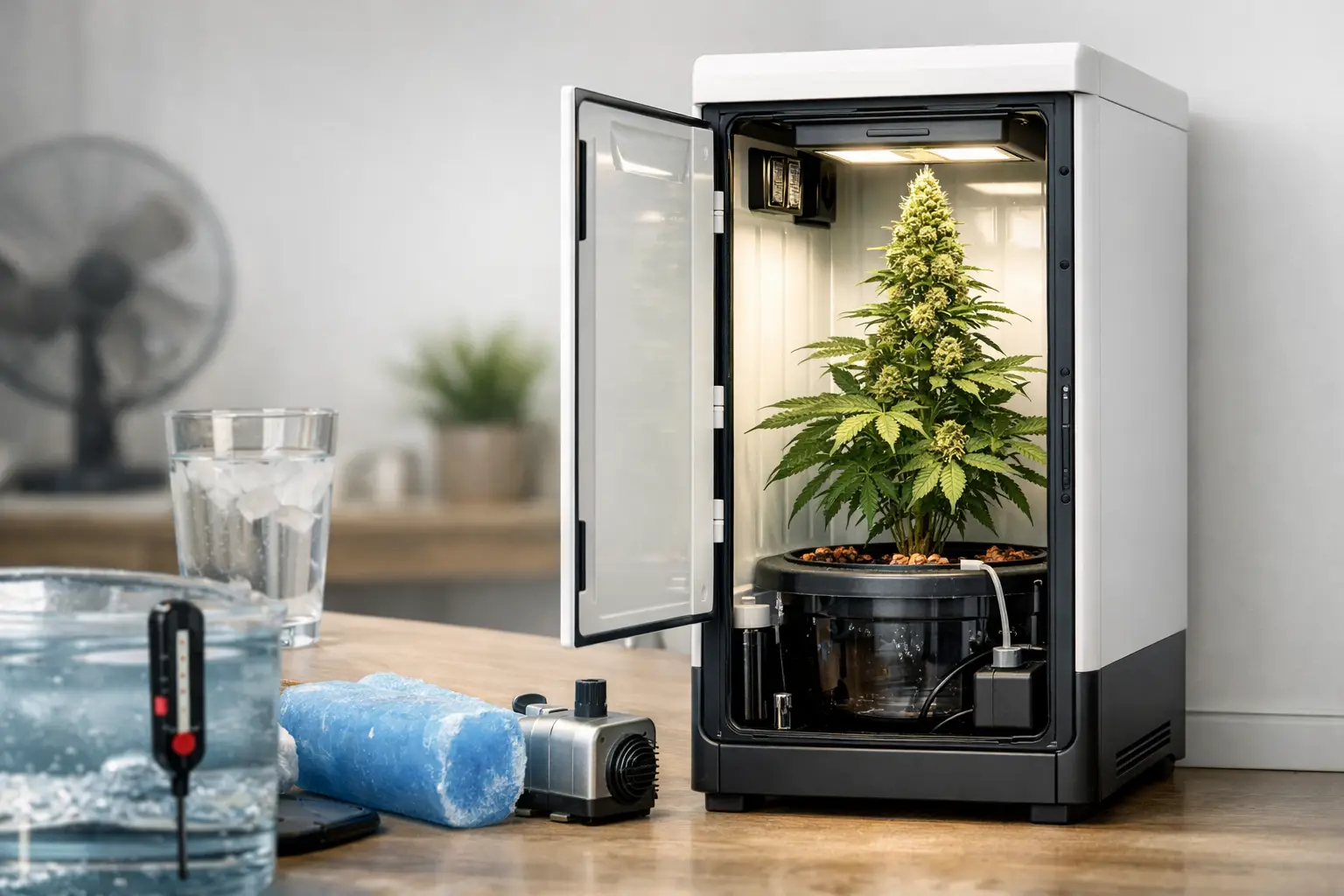
A DWC plant can look fine at lights-on, then lose its edge over three days for one boring reason: the water is too warm. DWC reservoir temperature problems are not minor comfort issues. In a small cabinet or tent, warm nutrient solution strips oxygen from the root zone, speeds up biological trouble, and turns a clean run into avoidable drama.
For compact cannabis growing, reservoir temperature is a control point, not a number to glance at when something goes wrong. Get it readable early and the plant drinks, feeds, and recovers predictably. Ignore it, and you may start chasing pH, nutrients, genetics, or additives when the real problem is heat.
The Target Range for a DWC Reservoir
Keep nutrient solution between 65 and 68°F. That range gives roots good dissolved oxygen while keeping nutrient uptake active. A reservoir at 69 or 70°F is not automatically a disaster, especially if it only peaks briefly. But once the solution spends long periods above 72°F, the margin for error gets thin fast.
Warm water holds less dissolved oxygen. At the same time, roots and microbes become more active as temperatures rise. That creates the wrong kind of demand: the root zone needs more oxygen while the water carries less of it. In a compact enclosure where roots are already sharing limited water volume, that imbalance can show up quickly.
Cold water has its own cost. Below roughly 62°F, root activity slows, nutrient uptake can become sluggish, and plants may show deficiency-like symptoms even when the solution is mixed correctly. Do not solve a 75°F problem by swinging the reservoir down to 58°F. Stability beats aggressive correction.
How Temperature Problems Show Up on the Plant
The first symptom is often slower growth, not obvious root rot. New leaves may lose their pace, branches stop reaching, and the plant seems to need longer to recover after training or a reservoir change. Because those signs are vague, many growers respond by increasing nutrient strength. That usually makes a stressed root zone work harder.
As heat stress builds, watch for drooping that does not match the moisture level of the medium, pale new growth, edge burn despite a reasonable EC, or a plant that drinks less than expected. In flower, the plant may look generally tired, with smaller-than-expected bud development and less daily water use.
The reservoir gives clearer evidence than the leaves. Healthy DWC roots are generally white to cream-colored, firm, and fresh-smelling. Nutrient staining can tint roots tan, especially with organic additives, so color alone is not a verdict. What matters is texture and smell. Slimy roots, brown decay, or a sour, swampy odor mean you are past simple temperature management and into root-zone triage.
Why Small Grow Spaces Run Warm
A cabinet grow does not need a giant lighting system to overheat a reservoir. The problem is accumulation. A light warms the enclosure, warm air heats the lid and bucket, an air pump transfers a little heat into the water, and a small reservoir has little thermal mass to resist the change.
The most common causes are simple: the reservoir sits inside the lit cabinet, the lid is exposed to warm air, the nutrient volume is too low, or the room outside the cabinet is already hot. A black bucket can block light, but it also absorbs heat if it sits near a warm wall or receives direct sunlight. Pumps, chillers, and air stones matter, but placement and room conditions usually matter first.
Measure the nutrient solution itself with a reliable waterproof thermometer. Do not treat cabinet air temperature as reservoir temperature. Check it at the warmest point of the light cycle and again shortly before lights-on. A single reading at a convenient time tells you almost nothing about the daily high.
Fix DWC Reservoir Temperature Problems in the Right Order
Start with the cheapest correction that addresses the actual heat source. If your room is 82°F all day, frozen bottles are a temporary patch, not a system. Bring the surrounding room and enclosure temperature under control first. In a VGrow-style cabinet, that may mean adjusting the light schedule so the fixture runs during the coolest part of the day, improving exhaust performance, or reducing light intensity when the plant and space cannot support full power.
Next, isolate the reservoir from heat. Keep the bucket out of direct light, raise it off a warm floor, and make sure hot exhaust is not blowing over the lid. Reflective insulation around the bucket can slow heat gain, but it cannot overcome a hot room. Insulate the lid as well if it is the surface receiving the most radiant heat.
Increase solution volume if the system allows it. More water changes temperature more slowly. This is one reason tiny DWC containers are unforgiving: they can heat up, concentrate nutrients, and swing pH in the same afternoon. Bigger is not always better in a cabinet, because every gallon takes space and adds handling weight. But a reservoir that is barely adequate for the plant creates daily instability.
If the reservoir only rises a few degrees during lights-on, frozen water bottles can be useful. Use clean, sealed bottles and rotate them based on measured temperature, not guesswork. Do not toss in loose ice. It dilutes the nutrient solution and makes repeatable management impossible. Also avoid dropping several frozen bottles in at once. A sharp temperature swing stresses roots just as surely as sustained heat.
A water chiller is the cleanest mechanical answer when room temperatures stay high and your grow runs year-round. It is also expensive, takes floor space, and adds another piece of equipment to maintain. For a compact, disciplined run, first determine whether changing the light schedule, cooling the room, and insulating the reservoir solve the problem. Buy the chiller when the environment has proven it needs one, not because a forum made it sound mandatory.
Aeration Helps, but It Does Not Cool Water
A strong air pump and properly sized air stone are standard DWC equipment because roots need oxygen. They help maintain a healthier root zone, especially when temperatures drift slightly high. They do not make 75°F water equivalent to 67°F water.
Keep the air pump outside the warm cabinet where possible. It will draw cooler air, run cooler itself, and avoid adding unnecessary heat to the enclosure. Use clean tubing, make sure the air stone produces an even stream of fine bubbles, and replace clogged stones. Good aeration is insurance, not permission to run a hot reservoir.
When Heat Has Already Damaged the Root Zone
If the reservoir is warm and roots smell bad or feel slimy, stop making random adjustments. First, correct the temperature source. Then remove the plant from the system carefully, drain the reservoir, and clean the bucket, lid, air stone, tubing, and net pot where practical. Refill with fresh, properly mixed solution at the correct temperature.
Whether you use a sterile approach or beneficial microbes depends on your chosen system. Do not mix methods casually. Sterile products and living inoculants are built around different root-zone strategies, and combining them can waste both. Pick one approach, follow its label directions, and keep temperature and sanitation under control. No bottle can compensate for a reservoir that spends every afternoon overheating.
Reduce stress while the plant recovers. Keep EC conservative, maintain stable pH, and avoid heavy training until new roots look healthy and the plant resumes normal drinking. The goal is not to force fast growth this week. The goal is to restore a clean, oxygen-rich root zone that can support the rest of the run.
Build Temperature Checks Into Your Daily Workflow
Temperature management works best when it is boring. Record reservoir temperature at the daily high and low, note the water level, and pay attention to how much the plant drinks. Those three observations reveal more than a pile of additives and emergency fixes.
If you are repeatedly fighting warm water, treat that as feedback about method-to-space alignment. A compact DWC grow can produce excellent flower, but it asks for tighter environmental control than a larger, buffered system. Build the workflow around stable conditions, and the roots will do their job quietly. That is the kind of clean run worth repeating.