DWC Root Rot Symptoms You Shouldn’t Miss
Spot dwc root rot symptoms early and fix the real cause fast. Learn what unhealthy roots, smells, slime, and leaf stress are telling you.
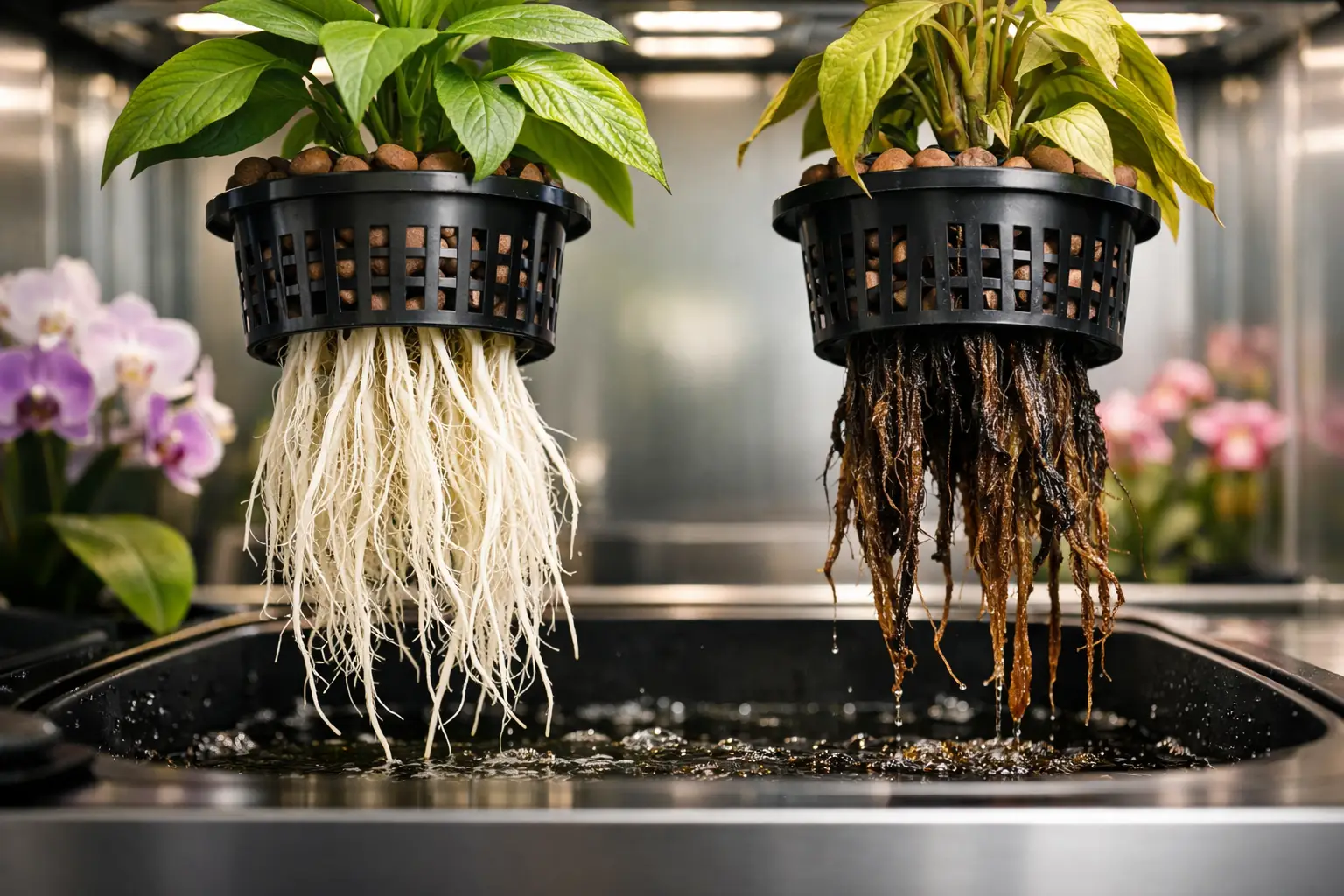
You usually do not notice root rot when it starts. You notice it when the plant stops acting like itself. Growth stalls, leaves lose posture, the reservoir smells off, and suddenly your clean DWC run turns into root-zone drama. That is why learning dwc root rot symptoms matters. In a compact indoor grow, small mistakes stack fast, and the root zone can go from healthy to ugly in a day or two.
DWC is simple when the basics stay clean, cool, and oxygenated. It gets messy when growers chase leaf symptoms while ignoring the bucket. Root rot is not just a root problem. It is a system problem, and the plant will tell you that long before it fully crashes if you know what to look for.
The earliest dwc root rot symptoms
The first sign is often not brown roots. It is a change in plant behavior. A healthy DWC plant usually looks alert, drinks steadily, and grows with visible momentum. When root rot starts, that rhythm breaks.
You may see drooping that does not match your water level or room conditions. Leaves can look tired even though the reservoir is full and the air temp is fine. New growth may come in smaller than expected. The plant can stop drinking at its normal rate, or the water level may barely move over 24 hours. In hydro, that slowdown matters.
Another early clue is a slight reservoir smell. Healthy roots and clean water should not hit you with a swampy, sour, or stale odor. If opening the lid gives you a funk instead of a neutral smell, do not talk yourself out of it. That is often the point where a disciplined grower checks roots immediately instead of waiting for leaf damage.
What unhealthy roots actually look like
Root color alone is not enough. Some nutrients, additives, and beneficial products can stain roots tan. The question is not whether the roots are perfectly white. The question is whether they still look alive.
Healthy roots tend to look bright, firm, and fibrous. They spread outward with lots of fine branching. They do not clump together into a slick mass. They should feel clean, not greasy.
Rotting roots usually start losing that structure. You may see beige turning to darker tan or brown, but the bigger warning is texture. Roots become slimy, matted, and weak. Instead of hanging freely in the water, they can fuse together. In worse cases, they shed outer tissue when handled. If the roots look like wet strings coated in muck, you are not dealing with a minor issue.
Smell confirms a lot here. If the roots look stained but smell clean and feel firm, you may be fine. If they look dull, feel slick, and smell rotten, you are not.
Above-ground symptoms that point to root rot
Beginners often misread root rot as a deficiency, overfeeding, or light stress. That is how they lose time. In DWC, root problems show up everywhere because the roots control water and nutrient uptake.
Leaves may droop during the light cycle even with enough water in the bucket. You can also see yellowing that starts without a clear feeding pattern. Sometimes the plant shows multiple deficiency-like signals at once, which is a clue that the roots are failing broadly rather than missing one specific element.
Tips can burn while lower leaves fade. Edges may curl. Growth can look pale and stalled. In flower, the plant may stop stacking properly and start aging too early. None of those signs prove root rot on their own, but when they show up with bad-smelling water or ugly roots, the picture gets pretty clear.
A common trap in small-space grows is blaming the canopy first because that is what you see every day. But in hydro, the bucket is often the real story.
Why DWC root rot happens
Root rot does not appear out of nowhere. It usually shows up when oxygen, temperature, sanitation, and biology get out of balance.
Warm water is a major driver. As reservoir temperature rises, dissolved oxygen drops. That makes life harder for roots and easier for pathogens. In many home grows, especially cabinets and small tents, heat from pumps, lighting, and ambient room conditions pushes the root zone into a danger zone without the grower realizing it.
Low oxygen is another big one. Weak aeration, undersized air pumps, kinked tubing, or failing air stones reduce the constant oxygen supply DWC depends on. Roots sitting in under-aerated water are stressed before they ever show visual damage.
Then there is cleanliness. Light leaks into the reservoir, dirty equipment, old organic residue, dead root matter, and sloppy changeout practices all create conditions where microbes can get out of control. Some growers try to run too many additives in a system they are not keeping clean enough. That is a method mismatch. In a compact setup, clarity beats complexity.
It also depends on plant size and bucket size. A fast-growing plant in a small reservoir can shift water temperature, pH, and oxygen demand faster than a beginner expects. What worked in early veg may stop working once the roots fill the bucket.
How to tell root rot from staining or nutrient issues
This is where growers either stay calm and diagnose correctly or start throwing random fixes at the plant.
If roots are light tan from nutrients but still smell neutral, feel firm, and support strong growth, that is usually staining. If the plant is drinking, praying, and pushing healthy new growth, you likely do not have active rot.
If the plant looks stressed but roots are still mostly clean, check pH drift, EC strength, water level, and environment before assuming disease. DWC can punish sloppy feeding and poor climate control with symptoms that overlap.
But if you have three things at once - foul smell, slimy texture, and stalled growth - treat it as root rot until proven otherwise. Waiting for certainty is how minor damage becomes plant loss.
What to do the moment you see dwc root rot symptoms
Start by lifting the lid and inspecting the full root mass. Do not guess from the leaves. If the roots are slimy or smell rotten, act the same day.
Change the reservoir immediately. Clean the bucket, airlines, lid, and any surfaces that contact nutrient solution. If your method uses a sterile approach, reset with clean water and the products that fit that approach. If your method uses beneficial microbes, reestablish them after cleaning in a way that makes sense for the system. Do not mix philosophies blindly. Pick a lane and run it cleanly.
Lower reservoir temperature if heat is part of the problem. Improve aeration if the current air pump setup is marginal. In a small grow, this might mean a stronger pump, a better air stone, less heat transfer into the bucket, or simply getting the room itself under better control.
Trim obviously dead root material only if it is clearly decomposing and easy to remove. Do not hack at the root mass in a panic. The plant already has reduced uptake capacity. Rough handling can make recovery harder.
Then simplify everything else. Do not add five rescue products because the internet said so. Stabilize water quality, oxygen, and temperature first. The root zone needs order, not a chemistry experiment.
Preventing it on the next run
Most root rot prevention is boring, which is exactly why it works. Keep light out of the reservoir. Keep the water well oxygenated. Keep temperatures in range. Keep your cleaning routine tight between runs and disciplined during the run.
Match the method to the space. If your cabinet runs warm, do not pretend your reservoir is immune. If your setup is small and your environment swings, build around that reality instead of copying a larger-room grow. Craft growing is not about forcing a method past its limits. It is about reading the system honestly.
It also helps to stop overcomplicating the bucket. Every additive, organic input, or half-understood trick increases the need for control. Beginners usually get better results from a cleaner, more readable process than from a crowded reservoir recipe.
A healthy DWC grow has a certain feel to it. The roots look active, the water smells clean, and the plant moves with purpose. Once you have seen that a few times, dwc root rot symptoms become much easier to catch early. That is the real advantage of a structured grow style. You stop reacting to chaos and start reading the plant before the damage gets expensive.