Comparison guide

Grow Room vs Grow Tent

Grow room vs grow tent is really a question about who builds the containment. A tent is a pre-engineered envelope: light-proof fabric, reflective lining, ports sized for ducting, a floor tray for spills, and a shape that makes a clean air path almost automatic. A converted room or closet gives you more space and more headroom, but every one of those jobs — sealing light, routing odor, holding climate, surviving cleanup — lands on you. For most home growers, the tent wins because it solves problems you would otherwise have to notice, design, and pay for one at a time.

The honest framing is not tent versus room as rivals. The tent is the default. The room is a graduation — one that makes sense only when your plant count, your routine, and your budget have already outgrown what tents can hold.

Tent fits when You want containment, light-proofing, and an odor path solved out of the box for a small footprint.
Room fits when You have outgrown multiple tents and are ready to build sealing, ventilation, and climate control yourself.
Decision rule Choose the smallest enclosure that holds your plant count — conditioned air is the cost you pay all run long.
What it means

A tent is a product. A room is a project.

When people search this phrase, they are usually staring at a spare room, a walk-in closet, or an unused corner and wondering whether a tent is worth buying when free space is already sitting there. The trap is that the space is not actually free. An open room becomes a grow room only after you light-proof the windows and door, protect the floor, create a filtered exhaust path, and accept that the room's climate is now your job for the entire run. A tent ships with most of that work already done, folded into a box.

A closet conversion sits in the middle and inherits the worst of both. It has room-style problems — door gaps that leak light, no built-in ports, painted drywall that absorbs moisture — inside a tent-sized volume that swings fast when the light comes on. Some growers make closets work, but almost all of the effort goes into rebuilding what a tent would have provided for less than the cost of the materials.

This page pairs with the enclosure question one step smaller: if your real comparison is between a tent and a furniture-style box, read cabinet grow vs grow tent alongside this one. Together they map the full enclosure ladder — cabinet, tent, room — and the same rule runs through all three rungs. The enclosure does not grow the plant. It decides how much of the environment you must build and defend yourself, and how visible your mistakes are while you do it.
Short version

A tent solves containment for you. A room makes you the contractor.

  • Tent: light-proof, reflective, ported, and floored on day one
  • Room: more space and headroom, every containment job DIY
  • Both: the air you condition, not the space you own, sets the real cost
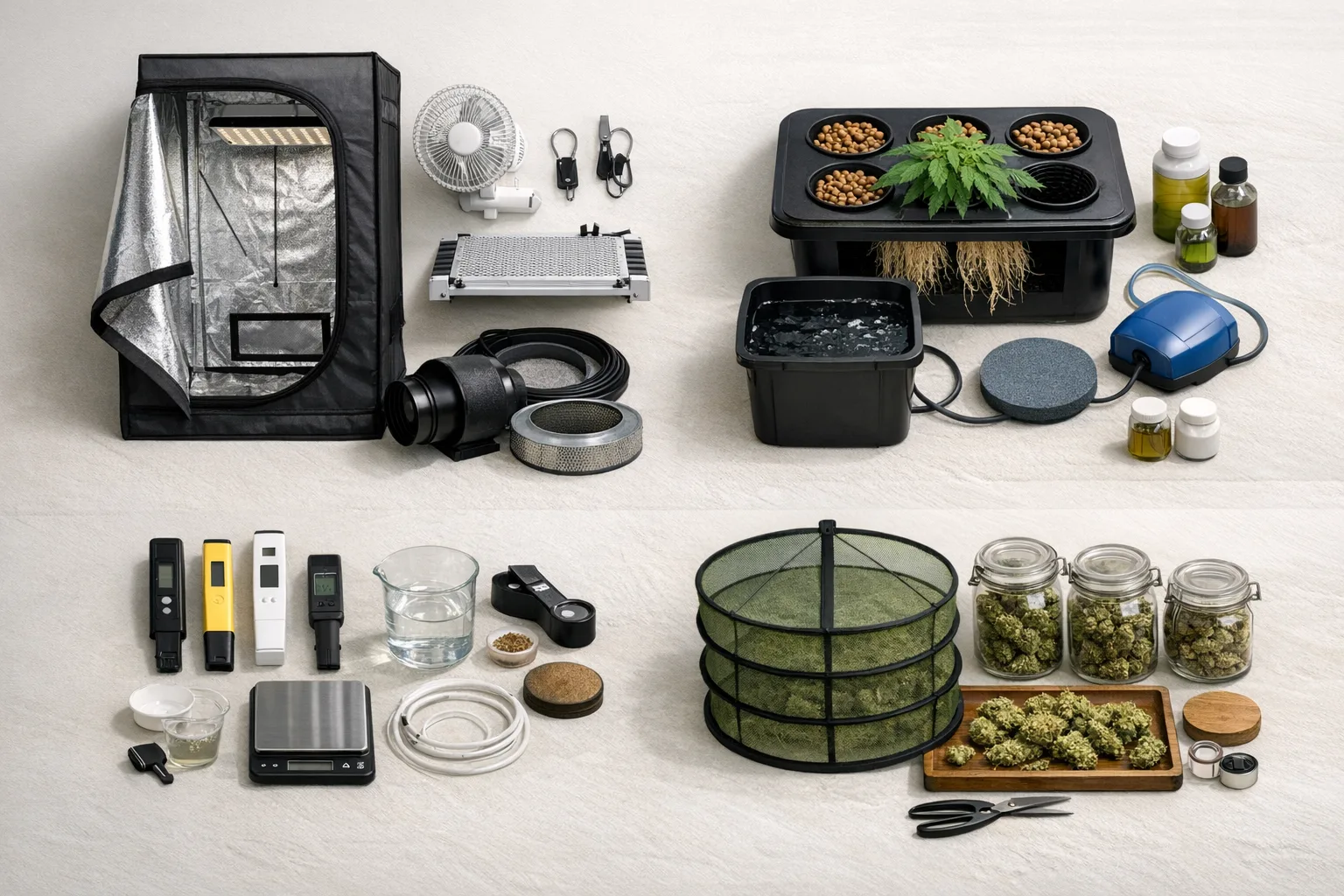
Overhead flat-lay of a compact grow kit: a tent with fan and filter, a DWC tub with rooted plant, hand meters, and a drying rack with jars.
A tent arrives as a finished containment system. A converted room has to rebuild every part of this by hand.
Containment, light, and odor

The room's biggest costs are the ones you cannot see on a receipt.

Light-proofing is the first hidden job. Flowering cannabis needs its dark period genuinely dark, and a room fights you on this from every direction: streetlight glow through blinds, the strip of hallway light under the door, the standby LEDs on power strips and chargers. Light leaking in during the dark hours can stress plants toward reveg or hermaphroditism late in flower; light leaking out announces the grow to the whole street. A tent handles both directions with black canvas and zippered seams, and a pinhole is a patch, not a renovation.

The odor path is the second. A tent gives you a defined route for air: passive intakes low, a carbon filter and inline fan pulling from the top, and slight negative pressure that keeps scent inside the canvas until it passes through the filter. The room version of that same system is leakier by nature — door undercuts, outlet boxes, and duct chases all bypass your filter, and if the room shares HVAC with the rest of the home, a return vent can carry odor house-wide before you smell it yourself. The principles in running a low-odor grow apply to both enclosures, but the tent starts from a sealed baseline and the room starts from a sieve.

Cleanup is the third. A tent wipes down: mylar walls, a removable spill tray, and a full teardown-and-disinfect reset that fits in an afternoon between runs. A room absorbs its history — drywall and carpet hold moisture and odor, corners collect debris, and a humid late-flower environment pressed against painted drywall for weeks is how mold problems start in the structure itself, not just on the plant. If pests or powdery mildew show up, resetting a tent is a chore; resetting a room is a small remediation job.

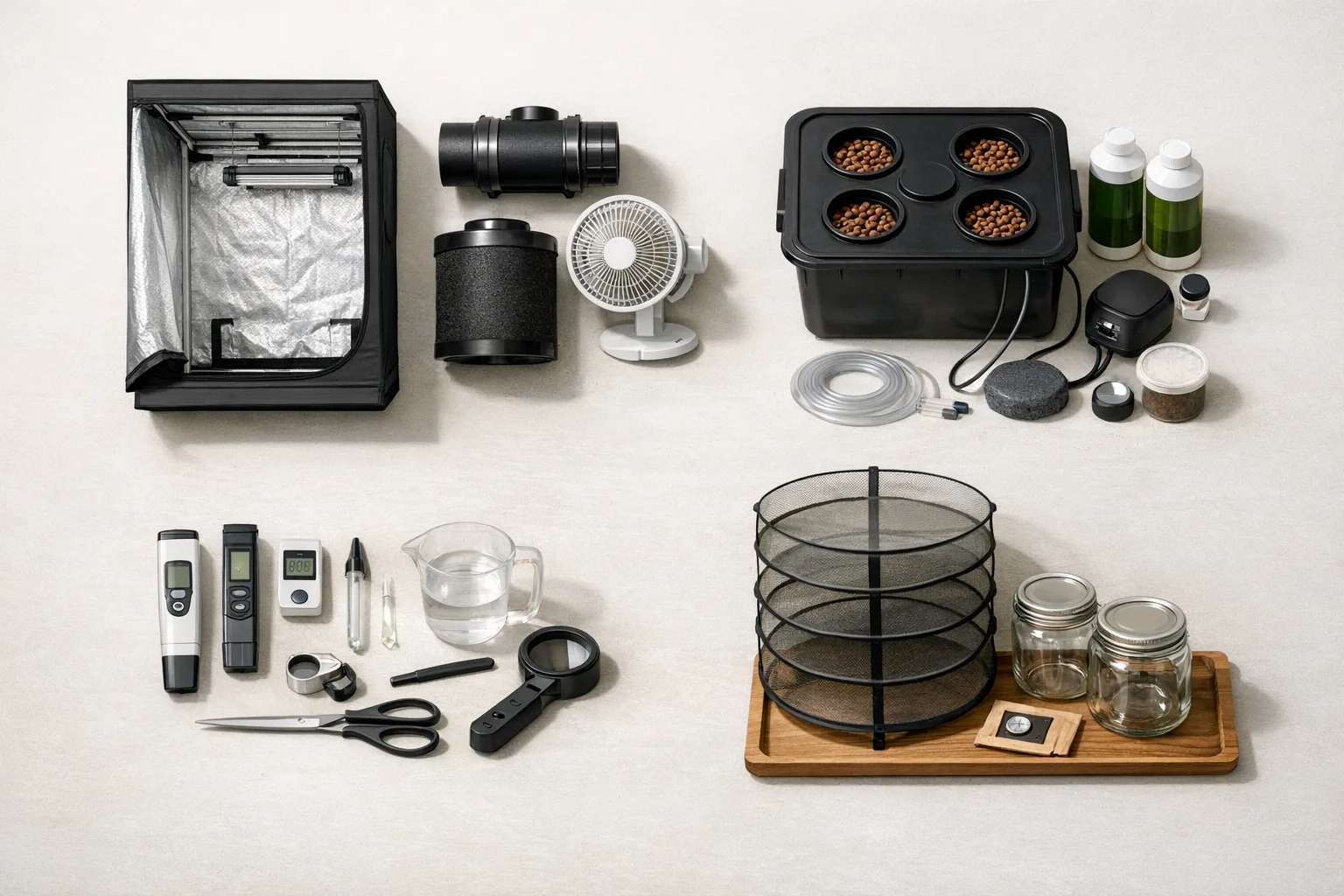
Overhead flat-lay of grow gear: an open tent, inline fan and carbon filter, a DWC tub with clay pebbles, hand meters, and a drying rack with jars.
Intake low, filter and fan high, negative pressure holding the smell — the air path a tent defines and a room must earn.
Climate load and cost

A room is a bigger HVAC problem, and you pay for it every day of the run.

The math is simple and unforgiving. A 4x4 tent holds roughly 100 cubic feet of air. A modest 10x10 spare room with an 8-foot ceiling holds about 800 — eight times the volume to heat, cool, and dehumidify before a single extra plant benefits. A small inline fan can exchange a tent's air every minute or two and a compact dehumidifier can hold its dry-down; the room needs a larger exhaust, a serious dehumidifier, and often dedicated cooling such as a mini-split or portable AC once the light load rises. Worse, the room's climate is coupled to the house: a hot afternoon, a cold snap, or the home's own HVAC cycling all push directly on your canopy, where a tent gets buffered by the lung room around it. The same physics that make a small cabinet hold moisture make a big room expensive to dry out.

Cost over a full run follows the volume. The tent's price is mostly upfront and visible: the canvas, a fan, a filter, a light sized to the footprint. The room's price hides in layers — paint or panda film, weatherstripping, a higher-capacity fan and filter, the dehumidifier, possibly an electrician for the added load — and then keeps charging you monthly, because every watt of conditioning serves air your plants may not even occupy. Priced per square foot of canopy actually flowering, a disciplined tent is almost always the cheaper machine, which is why apartment growers in particular tend to land there; the footprint logic in setting up a compact grow in an apartment is the same logic, one size down.

None of this means rooms are a mistake. It means the room's advantages — headroom, plant count, walk-in working comfort — are bought with containment work and conditioning costs that a tent simply does not charge. If you take the room path, the winning move is telling: experienced builders seal the walls with vapor barrier, define intake and exhaust ports, and hold the space under negative pressure. They build a room-sized tent, because the tent's design is the correct answer at any scale.

Side by side

Room vs tent vs cabinet at a glance.

Factor Grow room Grow tent Grow cabinet
Containment All DIY — sealing, reflective walls, and a spill plan you build yourself. Built in — mylar lining, waterproof tray, zippered light-tight seams. Built in and furniture-grade — the most contained footprint of the three.
Light-proofing Hardest — windows, door gaps, and standby LEDs all leak both ways. Strong out of the box — pinholes are patchable in minutes. Strong — door seals and a fixed shell do the work.
Odor path Leaky by nature — shared HVAC can carry smell through the home. Defined — filter, fan, and negative pressure in one short loop. Most concentrated smell, but the shortest path to the filter.
Climate load Largest — hundreds of cubic feet coupled to the whole house. Small volume buffered by the lung room around it. Tiny volume — stable room, stable box; warm room, fast swings.
Cost over a run Highest — conversion costs plus conditioning extra air daily. Lowest per square foot of flowering canopy. Higher upfront for the space, cheap to run day to day.
Cleanup and reset Drywall, floors, and corners absorb moisture, odor, and problems. Wipes down — full disinfect and reset in an afternoon. Small surfaces wipe fast; tight access slows deep cleaning.
Scale ceiling Highest — headroom and plant count to grow into. Medium — capped by footprint; scale by adding tents. Lowest — one small plant, done carefully.

Read the table as a ladder, not a contest. The cabinet buys maximum containment at minimum scale. The tent buys nearly the same containment with more room to work. The room buys scale and comfort at the price of building and powering everything the smaller enclosures include. Most growers should climb one rung at a time and only when the current rung is genuinely full.

When a room makes sense

Graduate to a room when the tent is the bottleneck, not the routine.

There is a real moment when a room is the right call. It usually looks like this: you are already running two or more tents cleanly, your daily grow checks are boringly consistent, your local plant allowance supports more canopy than your footprint holds, and you find yourself wanting standing headroom, a walk-in working lane, or genuinely separate veg and flower spaces on different light schedules. At that point the tent's ceiling — physical and literal — is the limiting factor, and the room's extra volume starts serving plants instead of just costing electricity.

Graduate deliberately. Budget the conversion like a build: vapor barrier or scrubbable walls, sealed light paths, ported intake and exhaust with the room held under slight negative pressure, a dehumidifier sized for the volume, cooling that does not depend on the house thermostat, and circuits that can carry the load safely. If that list reads as exciting, you are probably ready. If it reads as friction, stay in tents another run or two — a second tent is cheaper than half a room conversion and keeps veg and flower separation without any drywall work. The gear list for compact grows covers the tent-scale versions of every piece.

Quick read

The room is a promotion you earn with full tents, not a shortcut past them.

  • Multiple tents running cleanly before you commit to a room
  • Plant count and legal allowance that justify the volume
  • Budget for sealing, exhaust, dehumidification, and power
  • A plan to hold negative pressure — build a room-sized tent
Practical takeaway

Buy the tent first. Earn the room later.

If you are choosing your first enclosure, the tent is almost certainly the honest answer: it delivers containment, light-proofing, and a working odor path for less money and less risk than converting the space around it. Convert a room when full tents — not ambition — tell you to.

01 Size the canopy

Decide how many plants you will really run, then pick the smallest enclosure that holds them.

02 Price the air

Count the cubic feet you must light, vent, and dehumidify — that volume is your real running cost.

03 Trace the odor path

Know where every cubic foot of exhaust goes before the first week of flower, not during it.

04 Plan the reset

Choose the enclosure you can fully clean between runs — the next grow inherits this one's shortcuts.

FAQ

Questions people usually mean when they search this phrase.

Is a grow tent better than a grow room?

For most home growers, yes. A tent arrives light-proof, reflective, and ready to vent through a carbon filter, and it only asks you to condition around a hundred cubic feet of air. A room can outperform a tent at scale, but only after you have built the same containment by hand.

Is it cheaper to build a grow room or buy a grow tent?

A tent is almost always cheaper for the space it conditions. A basic tent kit costs less than sealing, light-proofing, and climate-controlling a full room, and the tent keeps running costs lower because you heat, cool, and dehumidify a fraction of the air volume every day of the run.

When should I switch from a grow tent to a grow room?

When the tent footprint, not your routine, is the real limit. If you are already running multiple tents cleanly, you need standing headroom or separate veg and flower spaces, and you are ready to seal, ventilate, and climate-control a room as deliberately as a tent does out of the box, graduating makes sense.