No Mystery: Everything in This Cabinet Is a Number
Every outcome in a compact grow traces to six numbers: light, temperature, humidity, root-zone oxygen, EC, and pH. What to measure, with what, and why.
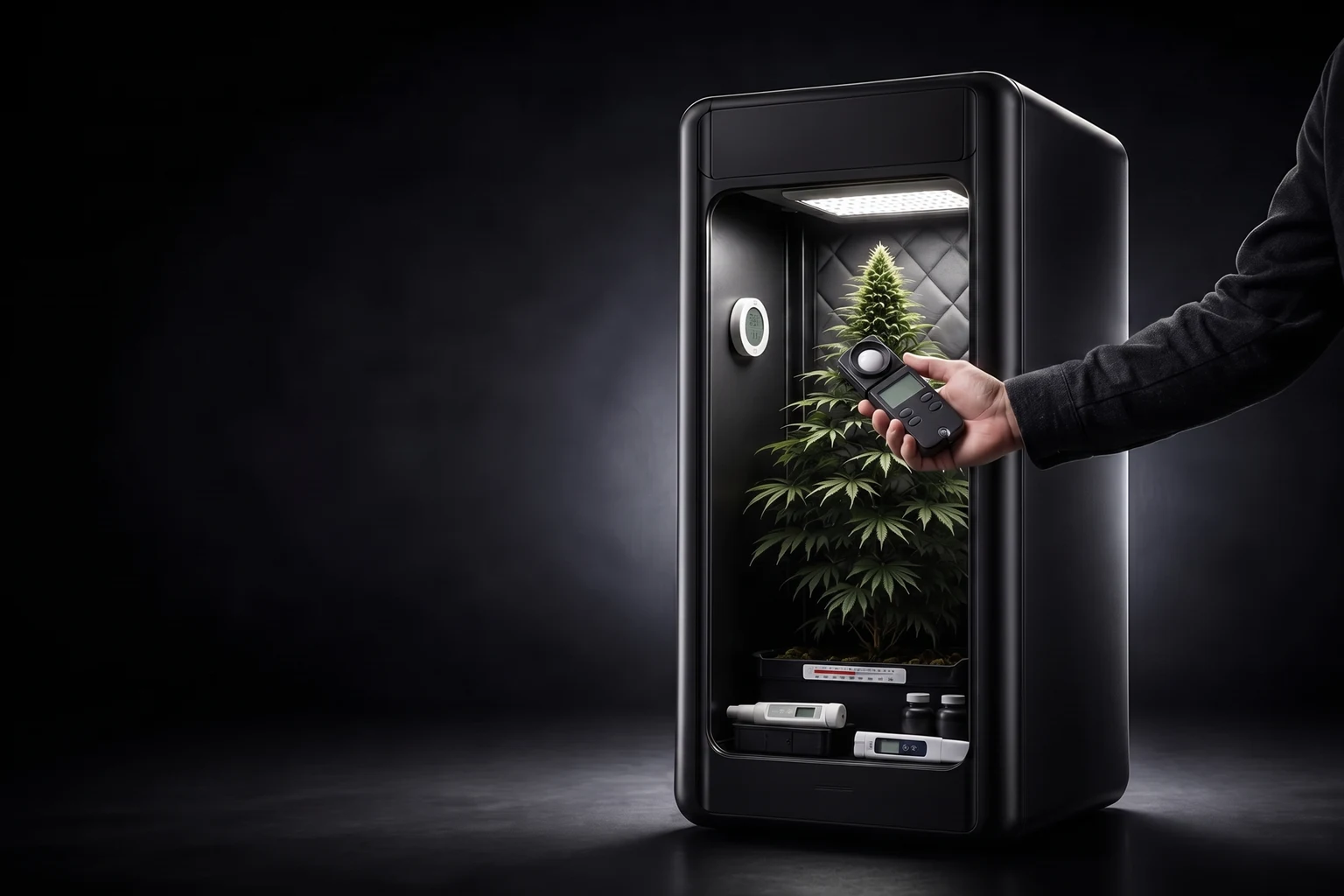
Ask ten growers why a run went sideways and you will hear ten stories: the genetics were weak, the nutrients were wrong, the moon was in the wrong phase. Ask what the canopy temperature was on day 40 and the room goes quiet. That silence is the problem this publication exists to end. A compact grow cabinet — or a small grow tent; the physics is identical — is not a mystery box. It is a small, sealed physics experiment, and every outcome inside it — vigor, aroma, mold, burnt tips, airy buds — traces back to six variables you can measure with instruments that together cost less than an ounce of mid-shelf flower.
This article opens a twelve-week season built on one premise: no mystery. Over the next three months we will teach each of these six numbers properly, show how they interact, run a fully logged grow in our own cabinet with every reading published, and finish by turning the same measurement literacy toward the dispensary shelf — labels, lab results, and the marketing words that fall apart when you ask them for a number. By the end, you will not need anyone's folklore. Including ours.
What a Controlled Environment Actually Controls
Strip away the gear catalog and a grow cabinet controls exactly six things. We will always list them in the same order, because the order is causal — energy comes in, climate responds, water and food move, chemistry decides what the roots can actually use:
- Light — the energy budget, measured as PPFD
- Temperature — where that energy ends up, measured at the canopy
- Humidity — the air's pull on the plant, measured as RH and read as VPD
- Root-zone oxygen — what the roots breathe, read through reservoir temperature
- EC — how much food is in the water, measured in mS/cm
- pH — which of that food is actually available, measured on the 0–14 pH scale
Memorize the order. It reappears on the daily logbook template we publish in week six, and again — in a form that may surprise you — on the buyer's checklist that closes the season. Six numbers, learned once, used everywhere.
1. Light: PPFD Is the Budget Everything Else Spends
Light is measured as PPFD — photosynthetic photon flux density, in micromoles per square meter per second. It is the single number that sets your ceiling: photosynthesis runs on photons, and research on cannabis has shown yield climbing essentially in step with intensity across the whole range a home cabinet can reach. For a compact cabinet, the working bands are 100–300 for seedlings, 300–600 in veg, and 600–900 in flower. Push much past that and the limit you hit first is not the plant's biology — it is your cabinet's ability to shed the heat.
Our light distance guide covers the other half of the problem — how hanging height and dimming interact in a compact cabinet — and this season links to it rather than repeating it. What no page has covered yet is how to actually measure PPFD without a $500 quantum meter — phone apps, cheap sensors, and exactly how far to trust them. That article arrives in week two.
2. Temperature: Measured at the Canopy, Not the Wall
Cannabis photosynthesis peaks with leaf tissue in the 25–30 °C range, which for a small LED cabinet translates to a lights-on target of roughly 75–84 °F in veg and 72–79 °F in flower, with nights around 8–10 °F cooler. Two details matter more than the setpoints. First, measure at canopy height — the reading at the cabinet wall can run several degrees off from what the plant experiences under the light. Second, under LEDs a leaf typically runs 1–2 °C cooler than the air around it, which quietly changes every humidity decision you make. Keep that in your pocket; it becomes important in about sixty seconds.
3. Humidity: RH Is the Reading, VPD Is the Meaning
Relative humidity is what your hygrometer shows: keep it roughly 55–70% in veg, 45–60% through flower, trending toward 40–50% at the finish, because sustained readings above 65% in a dense late canopy are an open invitation to bud rot. But RH alone is half a number. What the plant feels is vapor pressure deficit — VPD — the combined pull of temperature and humidity on its water supply, measured in kilopascals. Figured at the leaf, using that 1–2 °C LED offset, the bands run about 0.8–1.2 kPa in veg and 1.2–1.5 in late flower. Our VPD chart currently prints a hotter late-flower band; it gets corrected to these numbers this season — in the open, like everything else here — and week four is devoted to why VPD, not RH, is the master number of the middle of every run.
4. Root-Zone Oxygen: The Number You Read with a Thermometer
Here is the least intuitive entry, and the one that ends the most DWC runs. Roots drink oxygen dissolved in the water, and how much oxygen water can hold is set by its temperature: about 9.1 mg/L at 68 °F, falling to 7.6 mg/L at 86 °F — while warm roots and warm microbes demand more oxygen, not less. Below roughly 5 mg/L, roots slide into stress, and the opportunists take over: the pathogen behind classic root rot sits quietly in cool water and turns destructive in warm. That is why the cheapest instrument in this whole article — a reservoir thermometer, target 65–70 °F — is standing in for the most important thing your roots experience. Air pumps, stones, and how to size them by this number: week three.
5. EC: How Much Food Is in the Water — as One Number
Electrical conductivity tells you the total strength of your nutrient solution: roughly 0.4–0.8 mS/cm for seedlings, up through 1.2–1.8 in late veg, peaking at 1.5–2.0 in flower, then tapering. A caveat first: credible sources put flowering peaks anywhere from about 1.6 to 2.4 depending on cultivar, system, and irrigation style — DWC typically runs at the low end, which is where our bands sit. And two honesty notes our own archive has earned. First, if you have read our older feeding articles, you have seen these bands disagree with each other — three different charts in three different posts. In week five we retire all three and publish one canonical feeding chart, with the corrections stated in the open. Second, "ppm" without a scale name is a meaningless number: EC 2.0 is 1000 ppm on the 500 scale most US pens use and 1400 ppm on the 700 scale others use. This site prints EC first, labeled ppm second, always.
6. pH: The Number That Decides What the Roots May Eat
EC says how much food is in the water; pH decides which of it is on the menu. In hydro, nutrient availability lives inside a narrow band — run 5.5–6.2, aiming for 5.8–6.0 — because past roughly 6.5 iron and other micronutrients start dropping out of reach, and below 5.5 calcium and magnesium struggle while manganese can turn hostile. A pH pen is the one instrument here that lies to you slowly: the electrode ages, drifts, and needs a two-point calibration against 4.01 and 7.00 buffer solutions weekly. Drift within the band, by the way, is not an emergency — it is normal, and we will show you when to act on it and when to leave it alone.
No Number Exists Alone
Read the six entries again and notice they were never really separate. Light becomes heat at the canopy. Heat and humidity together set VPD. VPD sets how hard the plant drinks, which changes the water level, which concentrates the reservoir, which moves EC, which drags pH. One dial always moves the others — which is exactly why guessing fails: a symptom rarely stands next to its cause. Act two of this season (weeks four through six) is entirely about reading the numbers together, and it ends with the strongest evidence we can offer: a live, publicly logged run in our own cabinet, every reading dated and published as it happens.
The Two-Minute Daily Read
In practice, monitoring a compact cabinet is not a hobby inside your hobby. Once a day, same time, lights on: glance at PPFD only when you move the light or the canopy grows into it; read canopy temperature and RH off one hygrometer; read the reservoir thermometer; pen-test EC and pH twice a week or after any top-off. Write the numbers down — a habit that takes two minutes and turns "something looks off" into "RH has climbed four points in three days."
What This Costs, and What the Cabinet Already Does
The full instrument stack is modest: a combined thermometer-hygrometer, a stick-on reservoir thermometer, an EC pen, a pH pen with buffer solutions, and a light-measuring app or budget sensor. Assembled carefully, the set lands under about a hundred dollars. Integrated cabinets shortcut part of the list — our VGrow guide covers where its built-in sensing and app fit into this workflow — and this Thursday we republish our VGrow review the way a review should be written: actual interior measurements, actual wattage at each dimmer step, an actual 72-hour temperature and humidity log from inside the empty cabinet, and the honest limits. Measured, not guessed.
Three Misreadings to Retire on Day One
"More is better." It is not, and the evidence is specific: cannabis fed at double-strength EC showed no yield gain — the plant simply banks the excess while your risk of lockout grows. Every one of the six has a band, and the top of the band is not a target to beat.
"I just read the plant." Plants report late. By the time leaves curl or spot, the number that caused it has been wrong for days. Instruments are not a substitute for looking at your plant — they are how you catch what it is about to tell you.
"Just tell me the one perfect number." There isn't one. Cultivars differ, cabinets differ, seasons differ. Anyone selling you a single magic setpoint — for VPD, for EC, for anything — is selling folklore with a decimal point. Ranges, instruments, and your own log: that is the whole method.
Why This Makes Better Flower — and a Sharper Buyer
The payoff for measurement is not bragging rights; it is repeatability. A run you measured is a run you can repeat, and a run you can repeat is the only path to flower that is excellent on purpose. But there is a second payoff we suspect no other grow site will tell you about, and it is where this season ends: the same literacy that reads a hygrometer reads a label. Moisture, potency math, lab results, "premium," "infused" — the dispensary shelf is full of numbers and number-shaped marketing, and by late November you will be the customer who can tell them apart.
Six numbers. One order. Twelve weeks. Thursday we start where our own traffic tells us the readers already are: the cabinet itself, measured properly for the first time.