ColaXpress Grow Series — Episode 1

Can Automation Produce Craft Cannabis?

The series begins at zero. Empty reservoir. Fresh seed. Bare cabinet. This episode introduces the system, establishes the craft question, and follows the first 24 hours of environmental calibration inside the VIVOSUN vGrow.

Most growers chase yield. This series chases quality. The cabinet, the DWC reservoir, the humidifier — they are not the point. The composure they allow is the point.

System introduced vGrow cabinet, DWC reservoir, humidifier, sensors — the full interconnected environment.
The craft question Can a fully automated microclimate produce true craft flower — or just convenient flower?
Episode payoff First root emergence. The signal the plant has committed to the medium and the real grow begins.
Watch the episode

Episode 1 — The grow begins.

The episode runs approximately 20 to 25 minutes. The reading notes below go deeper on the concepts covered — use them alongside the video or as a standalone reference for the same material.

The craft premise

Quality is not created at harvest. It is preserved after it.

Most grow content measures success by weight — grams per watt, grams per plant, grams per square foot. That is a useful number for commercial operations. For craft growing, it is the wrong question entirely.

Craft cannabis is defined by the process: readable environment, disciplined harvest, careful drying, patient cure. The final jar either tells that story or it does not. This series is trying to find out whether an automated system can keep that story honest from the first seed to the last burp of the cure jar.

That is a fundamentally different goal than most grow channels pursue. It changes what gets measured, what gets documented, and what counts as a successful run.
The metric

Not how much. How well preserved.

  • Terpene expression — does the jar smell like the plant intended?
  • Moisture balance — does the flower hold together or crumble?
  • Smoke quality — smooth and complete, or harsh and uneven?
  • Jar behavior — does it settle and improve, or plateau and disappoint?
The system

Each component solves a different part of the compact-growing problem.

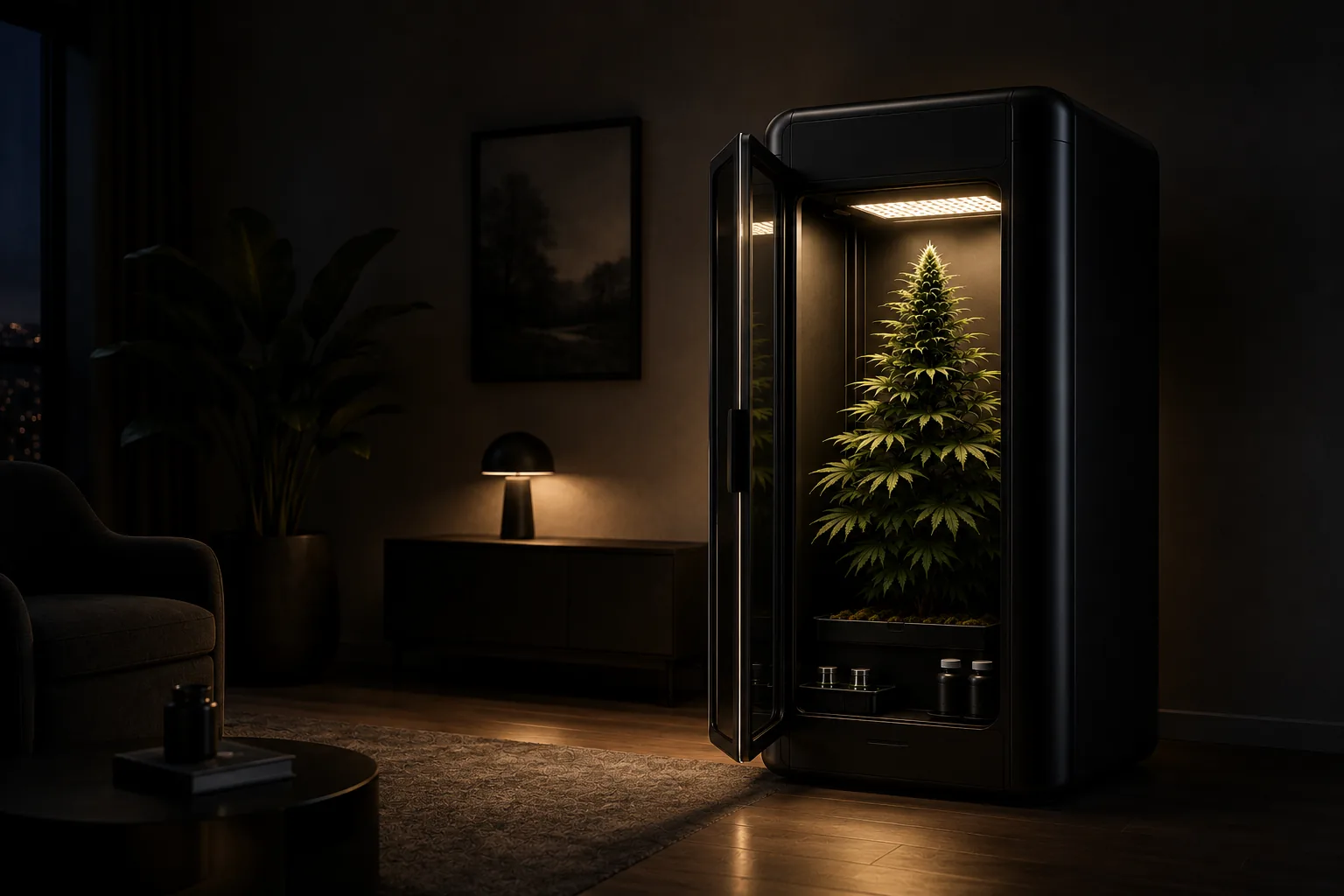
Compact VGrow-style grow cabinet and DWC reservoir setup arranged with pH, EC, aeration, and finish tools.
The cabinet contains the argument. The reservoir tells the truth. The humidifier mediates vapor pressure. The sensors read what the eye cannot.
VGrow

The cabinet holds the microclimate

The vGrow Smart Grow Box contains light, airflow, odor, and stage control inside one sealed environment. It keeps the grow readable instead of letting variables leak into a surrounding room that gets harder to interpret.

Stage selection — seedling, vegetative, flowering, drying — means the environment transitions with the plant instead of being manually reset at each phase.

DWC

The reservoir tells the truth

Deep water culture suspends the root zone in oxygenated nutrient solution. No soil. No medium. Just roots, water, dissolved oxygen, and constant feedback.

The roots become the most reliable visual indicator in the system. White, dense, branching roots mean the environment is doing its job. Anything else is the reservoir asking for intervention.

Vapor

The humidifier mediates the plant's breathing

Young plants absorb a significant portion of their water through their leaf surface rather than their roots. Humidity is not just comfort — it is nutrition delivery.

The humidifier maintains the vapor pressure environment that keeps stomata open at the right rate. Too dry and the plant restricts transpiration. Too wet and it creates conditions for mold and root stress.

Setup sequence

The order matters. The environment has to be stable before the seed goes in.

Field guide setup board showing the compact DWC workflow steps from placing the cabinet to starting the stage workflow.
The setup order is not arbitrary. Each step makes the next one more readable. Cabinet first. Reservoir calibrated. Environment set. Seed last.
Step 1 Cabinet placed and sealed

Position, intake airflow, and exhaust path confirmed before anything goes inside. The contained microclimate cannot be built afterward.

Step 2 Reservoir assembled and calibrated

Clean reservoir. Nutrient solution mixed at seedling-appropriate concentration. pH and EC confirmed. Air stones running. Water temperature checked.

Step 3 Environmental targets set

Seedling targets: 76 to 78°F, 65 to 70% relative humidity, VPD target 0.4 to 0.6 kPa. These numbers create a gentle environment for establishment.

Step 4 Seed placed

The plant enters a calibrated environment rather than an improvised one. Every stable variable is one less thing asking for correction in the first week.

Vapor pressure deficit

VPD is not a number to memorize. It is the relationship between temperature and humidity that controls how the plant breathes.

When VPD is calibrated correctly, the plant opens its stomata — the pores on its leaf surface — at the right rate. That balance directly influences how the plant takes in CO2, moves water, and allocates energy.

When VPD is too high — too dry, or too warm relative to humidity — the stomata close to prevent dehydration. Growth slows. Nutrient uptake drops. The plant is protecting itself instead of building itself.

This is why the humidifier matters more than it looks. It is not atmosphere. It is physiology management.

Root zone oxygenation

The sound of the air stones is the sound of the root zone staying alive.

Without sufficient dissolved oxygen, anaerobic bacteria colonize the root zone. Root rot follows quickly in warm conditions. The air stones prevent this by keeping oxygen saturation above the threshold the roots require.

In a properly maintained DWC system, roots are white, dense, and branching. They grow toward the aeration and away from light. They are one of the most reliable progress metrics in the entire grow.

If the roots look brown, smell off, or feel slimy, the root zone is sending a clear signal before the plant shows visible stress above. That is one of the key advantages of the DWC approach: the reservoir speaks before the canopy does.

First tension point

Small environments reach equilibrium differently than large ones.

Within the first 24 hours, the cabinet tests the setup. Sealed spaces amplify variables. One degree of temperature shift changes the VPD calculation. VPD changes affect transpiration rate. Transpiration affects how fast humidity rises. Humidity affects whether the environment stays in the target range or starts climbing past it.

The adjustment is not panic. The adjustment is observation. A small change. A wait. A re-read of the environment. Craft growers do not react. They calibrate.

That rhythm — observe, adjust, wait, re-read — is the same rhythm the series documents from seedling through cure. The system makes it more visible. The discipline makes it repeatable.

What this episode establishes

The environment has to stay disciplined through every phase. That is what the series is testing.

  • The cabinet can maintain a microclimate. Whether that microclimate stays craft-quality under load is the question.
  • The DWC reservoir gives faster feedback than soil. Root health becomes visible before canopy stress becomes visible.
  • The humidifier is not set and forgotten. VPD is a living relationship that changes as the plant grows.
  • First root emergence confirms the plant has committed. The real grow begins from that point.
What comes next

Episode 2 — Root development, nutrient dialing, and the first real signs of explosive growth.

Once the plant commits to the medium, the root zone starts demanding more from the environment. Episode 2 follows the reservoir readings, the first observable root development, and what the environment needs to do differently as the plant shifts from establishment into growth.

Ep 2

Root Development and Environmental Calibration

The root zone becomes the truth-telling layer. What healthy DWC roots look like, what stressed roots look like, and how the environment responds.

Coming soon
Series

All Episodes

See the full series arc — from first root through the harvest call, the slow dry, and the six-week cure that answers the question the series started with.

View all episodes
Go deeper

The site guides cover what the episode introduces.

VGrow

VGrow DWC System Guide

The full breakdown of how the cabinet, reservoir, stage controls, and finish plan function as one workflow rather than a pile of separate hardware.

Read guide
DWC

DWC Basics for Beginners

Oxygenation, pH, EC, root health, and why deep water culture fits compact craft growing so well.

Read guide
Craft

What Is Craft Cannabis?

The philosophy the entire series is testing — what the word means, why it gets diluted, and what process discipline makes it real.

Read guide
Roots

Root Problems in DWC

How to read root zone warnings before they become system-wide problems — oxygen loss, warm water, reservoir cleanliness, and off smells.

Read guide