Cannabis grow stage timeline: week by week from seed to harvest.
A compact DWC cannabis grow runs 14–18 weeks from seed depending on strain, training, and when you flip to 12/12. This timeline covers the standard photoperiod run with environmental targets — VPD, humidity, and light schedule — for each stage. Understanding the stages in sequence is what separates growers who react to problems from growers who prevent them.
The most common timing mistake is rushing vegetative. The second most common is holding flower too long chasing the perfect trichome window, which many growers say costs aroma.
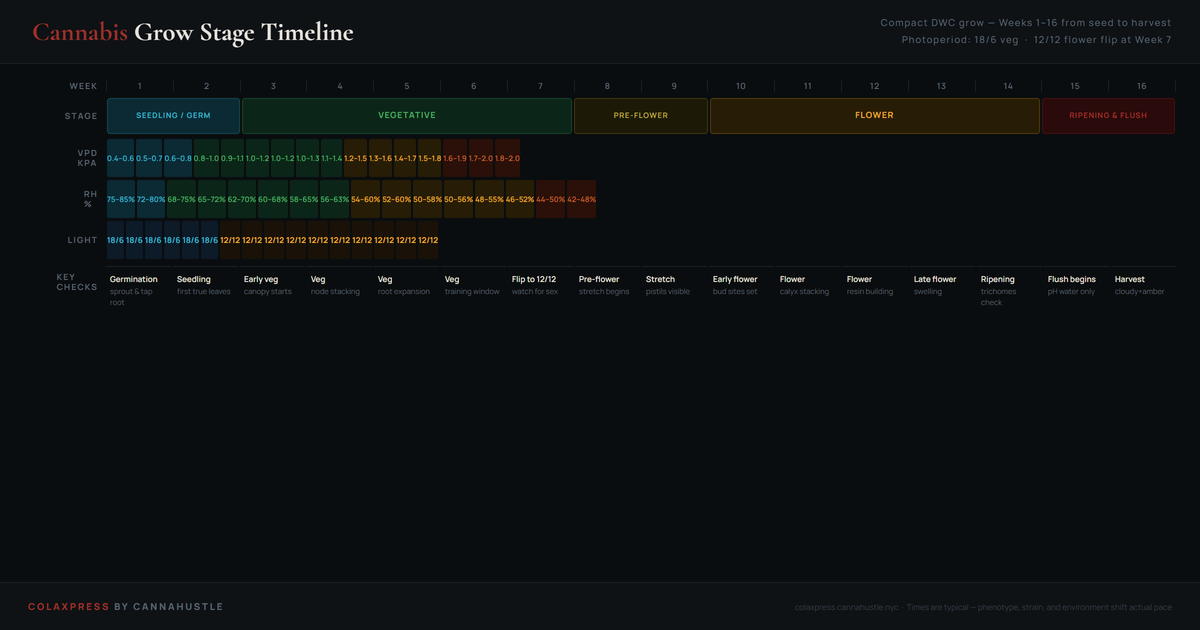
Stage-by-stage breakdown
Every stage of cannabis growth has a distinct environmental profile and a distinct set of priorities. Confusing them — treating a flowering plant like it is still in veg, or flipping too early and skipping the root development window — creates compound problems that show up weeks later and look like nutrient deficiencies or disease when they are actually environmental timing errors.
The timeline above shows a 16-week run. Real grows vary. Slow-developing strains may hold veg an extra week or two. Autoflowers skip the flip entirely. But the proportions hold: about one-third of the run is vegetative, two-thirds is reproductive. The environment should change with it.
| Stage | Weeks | Light |
|---|---|---|
| Seedling / Germ | 1–2 | 18/6 |
| Vegetative | 3–7 | 18/6 |
| Pre-Flower / Flip | 7–9 | 12/12 |
| Flower | 9–14 | 12/12 |
| Ripening / Flush | 14–16 | 12/12 |
Seedling
The seed has cracked, the tap root is down, and the first cotyledons are open. The plant has almost no ability to compensate for environmental stress. Keep VPD below 0.7 kPa, RH between 70–80%, and temperatures at 22–25°C. In DWC, use plain pH'd water or a very dilute seedling solution (EC below 0.5). Let the plant build roots before asking it to work.
Vegetative
The plant is now feeding actively. In DWC, the root mass grows visibly between checks. Ramp EC from 0.8 to 1.8 mS/cm across this window. VPD should land between 0.8–1.2 kPa. This is the training window — LST, topping, and defoliation all happen here. Do not flip to 12/12 until the canopy is the size you want after accounting for the height stretch that follows the flip (growers often quote 50–100%; no peer-reviewed figure exists).
12/12 Trigger
Switching to 12 hours light, 12 hours dark tells the plant that autumn has arrived. Within 1–2 weeks, sex becomes visible at the nodes — pistils (white hairs) for female, pollen sacs for male. The plant will keep stretching for roughly three to five weeks after the flip as it commits resources to reproduction, fastest from about day 5 to day 10; growers often quote 50–100% more height, but no peer-reviewed figure exists. Lower RH to 55–60% and begin transitioning nutrients toward bloom formula.
Flower
Bud sites are stacking. Resin production begins in earnest around week 10–11. This is where VPD management pays off most visibly — plants in the 1.2–1.6 kPa range produce noticeably more trichome coverage than those sitting high-humidity. Watch EC: DWC plants in late flower absorb water faster than nutrients, so EC creeps up. Top off with plain pH water between reservoir changes.
Ripening & Flush
Trichomes are shifting from clear to cloudy to amber. Read them on the calyxes (bracts), the site a 2025 review recommends; the common claim that sugar leaves amber earlier has never been tested. No amber target is validated: NC State Extension's CBD-hemp guide calls 20–30% amber its "best guess from observations," and other sources range from the first amber heads to about 30% amber. Many growers then flush, dropping EC to near zero with plain pH'd water for one to two weeks. That is grower practice, not a proven benefit: Stemeroff's 2017 University of Guelph thesis found a two-week flush ineffective at removing nutrients from the bud, and in Alden and Faust's 2025 CBD-hemp trial dry flower mass fell as flushes lengthened. No study links an amber percentage to a particular effect, so time harvest from trichomes, pistils and the calendar together.
Post-harvest environment
What happens in the first one to two weeks after harvest matters as much as the grow itself. No single drying humidity is proven: extension and commercial practice is 50–55% RH, home guides 55–62%. For a small home dry we treat 55–60% RH at 60–70°F as the safer finishing band, no higher than 62%, with gentle airflow and no direct light on the buds. A room held near 50% the whole way can over-dry flower unless you stop by measurement. Slower is not automatically safer either: a cool 14-day tray dry grew Alternaria mold on about 80% of one cultivar's buds (Birenboim et al., 2024). Our drying humidity guide has the full numbers. This is where flavor is preserved or lost.
Grow timeline questions
How long does cannabis take from seed to harvest?
A photoperiod cannabis plant in a compact DWC setup takes 14–18 weeks from seed to harvest: roughly 2 weeks seedling, 4–5 weeks vegetative, and 8–12 weeks of flower plus a final ripening and flush window of 1–2 weeks. Autoflowering strains finish faster — typically 10–14 weeks total — because they flower on age rather than a light schedule change. The timeline above shows a standard 16-week photoperiod run; your actual run depends on strain, training decisions, and when you flip.
How long should vegetative stage last in a compact grow?
Four to six weeks of vegetative growth is standard for a compact photoperiod grow. A common grower rule: flip to 12/12 when the plant is approximately half the final canopy height you want — plants keep stretching for about three to five weeks after the flip (growers often quote 50–100%, but no peer-reviewed stretch figure exists). Flipping too early results in low yield because the plant has insufficient mass to convert to flower; flipping too late means the canopy reaches the lights mid-flower with no room to recover. In a compact cabinet, most growers flip at week 5–6 with the plant at 30–45 cm.
How many weeks does cannabis take to flower?
Most photoperiod strains take 8–12 weeks from the 12/12 flip to harvest-ready trichomes, plus 1–2 weeks if you flush. Breeders and seed sellers list a flowering range for each cultivar; start from the listing for yours rather than the indica or sativa label, which in genetic studies tracks a strain's actual genetics poorly. Check calyx trichomes alongside the calendar, since identical strains can vary by a week or more depending on environment; in a 2026 six-cultivar study, the average calendar day (65 days after the flip) predicted the lab-measured cannabinoid peak more closely than trichome-color thresholds did.
What changes in the environment at the flip?
Three key variables shift when you flip to 12/12. Relative humidity drops from 55–70% in veg to 40–55% in late flower to prevent mold in the dense bud structure that develops. VPD rises from the 0.8–1.2 kPa vegetative range toward 1.2–2.0 kPa in late flower as you lower humidity. Nutrients transition from nitrogen-forward formulations to phosphorus and potassium-heavy bloom ratios — cutting nitrogen at the flip is not optional, as excess N in late flower suppresses resin and delays maturation. Temperature targets remain broadly consistent at 22–26°C throughout the grow.
Related guides
VPD chart for cannabis
kPa targets by grow stage — interactive temperature vs humidity reference grid.
Trichome stages chart
Clear, cloudy, and amber trichome stages — visual guide to the harvest window.