The craft finish

The ColaXpress Craft Cure: Fermentation Lids and Wine-Cooler Stability

Most cure guides hand you a mason jar and tell you to burp it twice a day for two weeks. That works, but it leans on the one thing growers are worst at: doing a fiddly thing consistently for a month. The craft cure removes the human from the loop. Two pieces do it: a wine cooler that holds a slow, cool, steady, dark environment, and a fermentation lid that vents the jar on its own. Set the conditions once, and the cure runs itself.

Slow. Cool. Steady. Dark. Patience in a bottle. The difference between a good cure and a legendary one is almost never effort — it is stability.

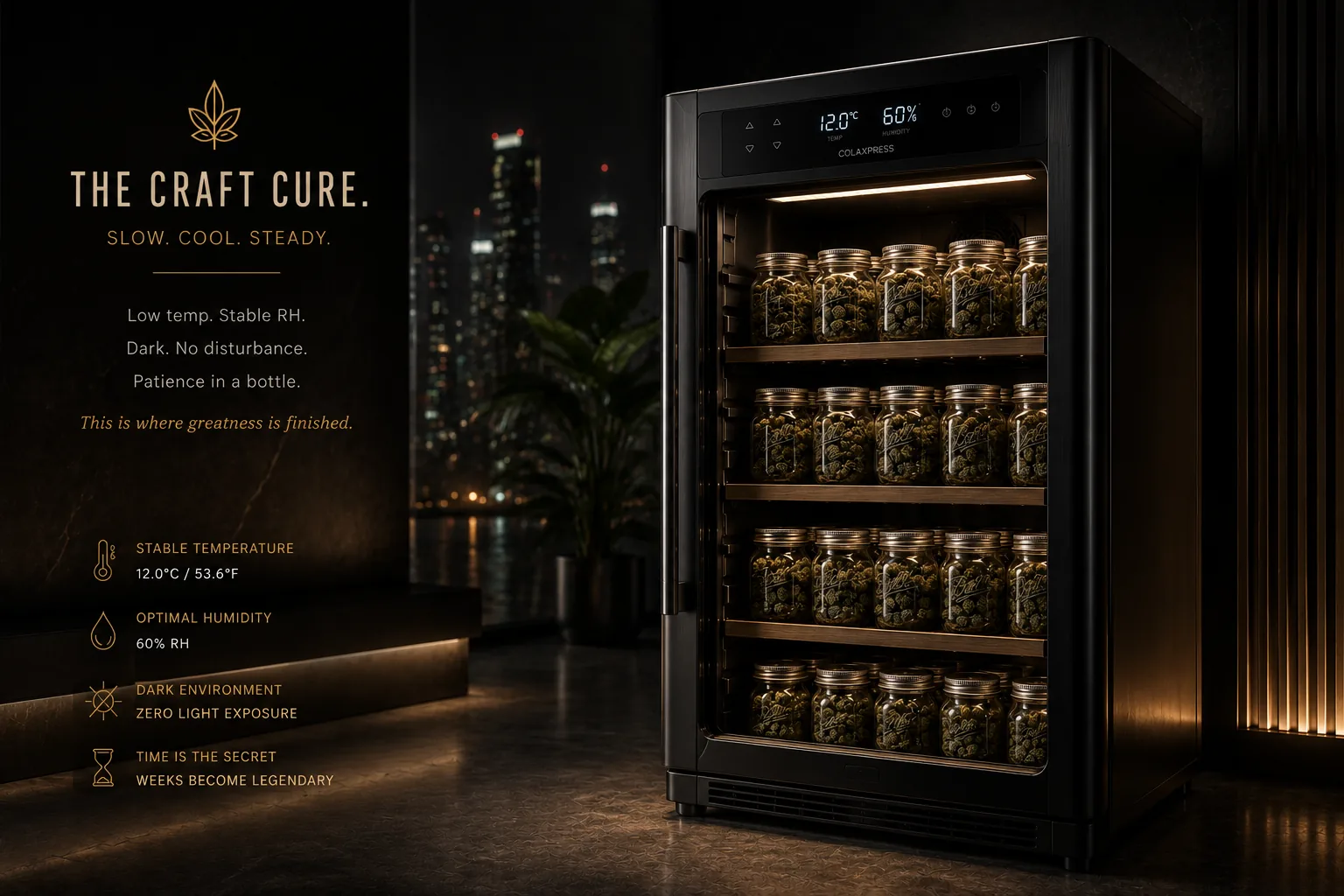
The environment A wine cooler holds ~53°F and ~60% RH in the dark — far steadier than any room.
The lid A one-way fermentation valve releases CO2 and moisture while sealing outside air out.
The payoff No daily burping, no humidity swings — a consistent cure that protects terpenes.
The ColaXpress craft cure: a wine cooler filled with cannabis curing in glass jars at a stable cool temperature, low humidity, and zero light.
The craft cure — slow, cool, steady, dark: jars curing in a temperature-controlled wine cooler at roughly 53°F and 60% RH.
The environment is the cure

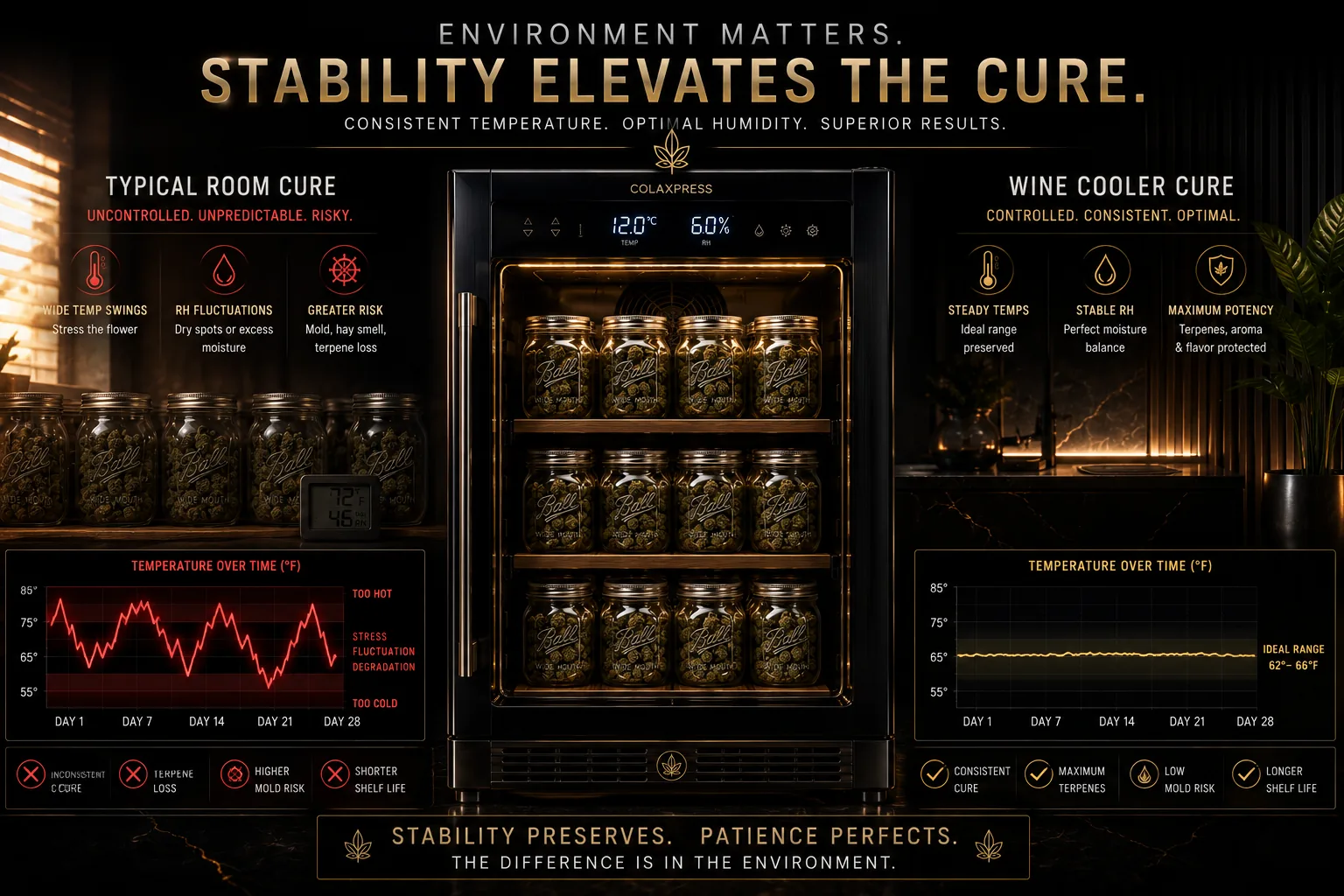
Stability elevates the cure — a wine cooler holds what a room can't.

A cure is an enzymatic process, and enzymes hate change. A bedroom or a closet swings several degrees and several points of humidity across a day — every spike nudges moisture in and out of the bud and stresses the flower. A wine cooler does one thing exceptionally well: it holds a set temperature, in the dark, without drift. Park it around 53°F and let the jars sit, and the cure gets the one input it actually needs — time at a stable, cool, dark set point.

That stability is why the wine cooler is the ColaXpress signature. It is not about luxury for its own sake; it is the cheapest way to buy a genuinely controlled environment. Cool slows the chemistry so flavor develops instead of evaporating, and zero light protects the cannabinoids and terpenes the grow spent months building. For the underlying targets, see the drying and curing environment chart.

Comparison board: an uncontrolled room cure with swinging temperature versus a wine-cooler cure holding a steady temperature and humidity for the cure.
A room cure swings; a wine-cooler cure holds a flat line. Stability preserves; patience perfects.
The fermentation lid

Engineered for a better cure: a lid that vents itself.

Cutaway diagram of a cannabis fermentation curing lid: lid shell, food-grade gasket, one-way valve, and flow chamber that release CO2 while keeping outside air out.
The fermentation lid: a one-way valve releases CO2 and excess moisture as pressure builds, then seals — keeping outside air out and the cure stable.

The fermentation lid borrows a trick from winemaking. A food-grade gasket and a one-way valve let internal pressure — CO2 and moisture released by the curing flower — escape when it builds, then close automatically when pressure equalizes. Outside air, with its fluctuating humidity and airborne contaminants, never gets in. The jar self-regulates toward a stable internal humidity instead of being yanked open twice a day. Less intervention, more stability, better results.

Lid vs daily burping

The old way is manual and risky. The craft way is automatic.

Comparison of daily jar burping versus a fermentation lid: manual burping swings humidity while the fermentation lid holds a stable cure with no daily intervention.
Daily burping introduces oxygen, swings humidity, and depends on you remembering. The fermentation lid holds a steady line for weeks with no daily intervention.

Daily burping is not wrong — it is just fragile. Every time you open a jar you introduce oxygen, drop the humidity, and reset the equilibrium the cure was building, and you have to do it perfectly for weeks. Miss a few days and you risk anaerobic spoilage; over-burp in a dry room and you lock in hay. The fermentation lid removes the variance: stable humidity, controlled gas exchange, preserved terpenes, set-and-forget. Paired with the wine cooler, the two inputs the cure actually depends on — environment and air exchange — are both handled by hardware, not habit.

The payoff

The final step, the greatest reward.

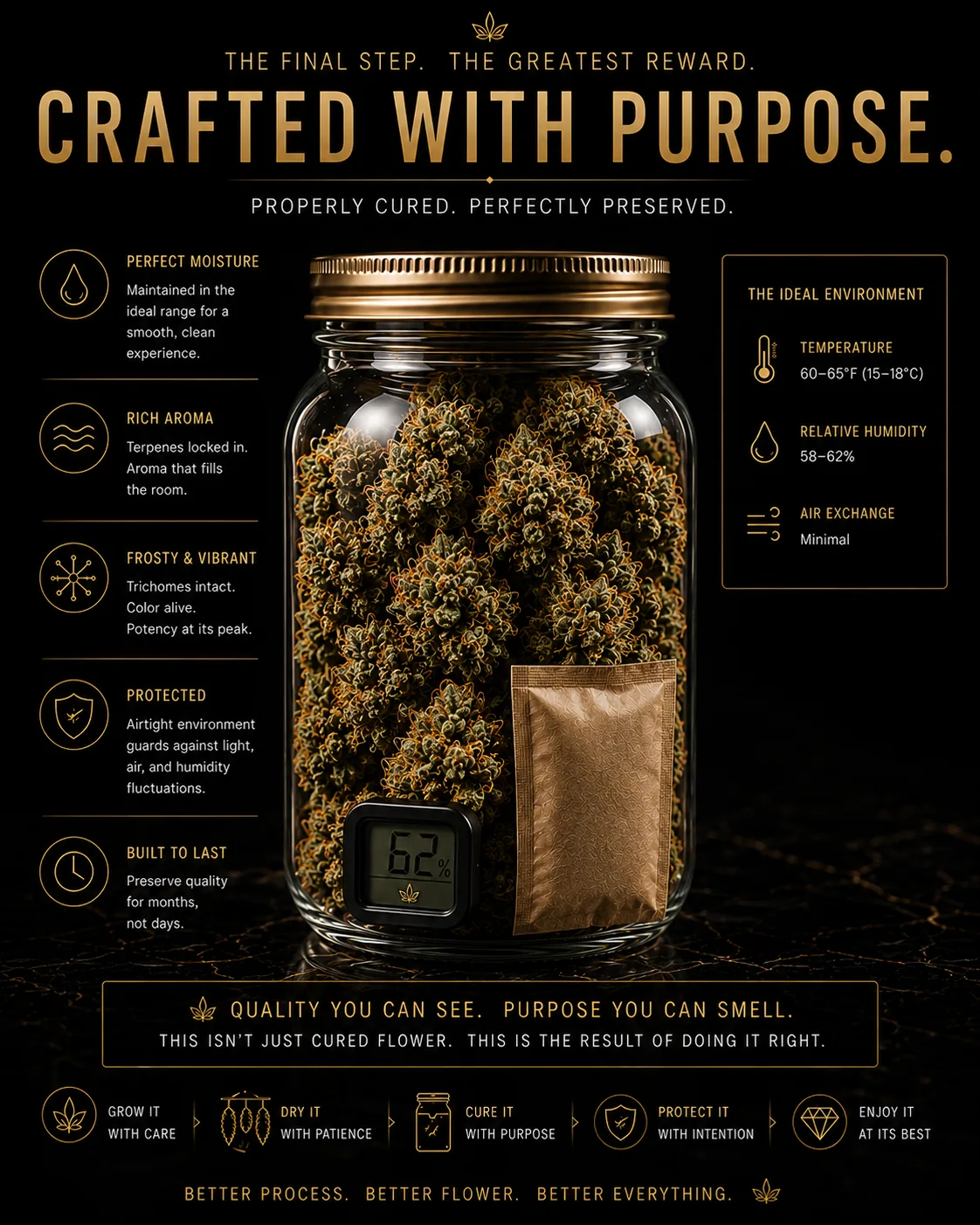
Do the dull parts right — a controlled dark dry, a stable wine-cooler cure, a self-venting lid — and the flower rewards you: full terpene expression, frosty intact trichomes, rich colour, and a smooth, clean smoke. The craft cure is not about effort on the day. It is about a stable environment doing the work over weeks, so the jar keeps getting better instead of going wrong. Quality you can see; purpose you can smell.

A jar of craft-cured cannabis flower with a hygrometer reading 62 percent, presented as the finished reward of a properly dried and cured harvest.
The greatest reward: a jar of craft-cured flower held at its ideal moisture.
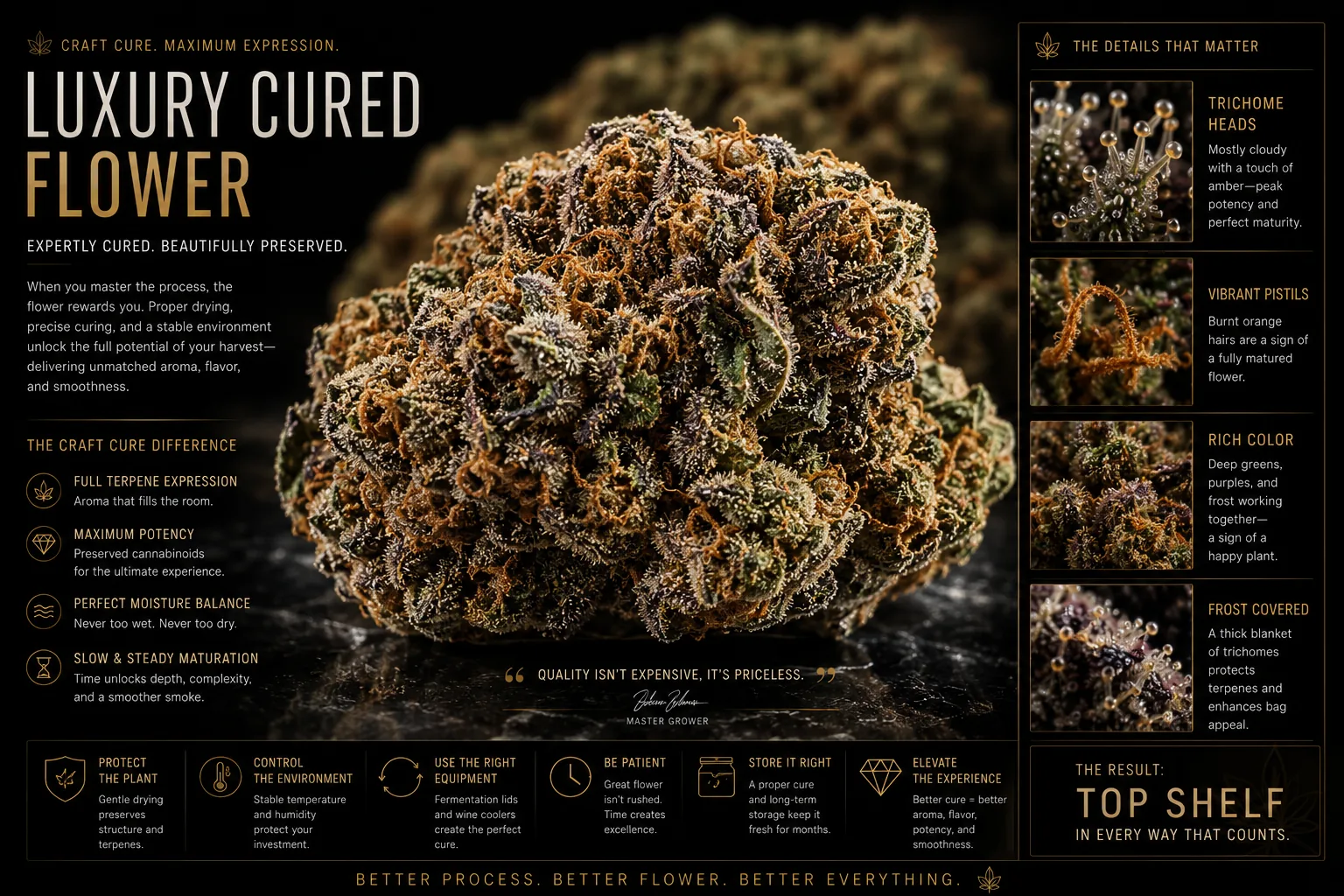
Macro of a top-shelf craft-cured cannabis bud with intact frosty trichomes, vibrant pistils, and rich color - the result of a slow, stable cure.
Luxury cured flower: full terpene expression, frosty trichomes, rich colour — top shelf in every way that counts.

Craft cure questions

Do I still need to burp jars with a fermentation lid?

No — that is the point. The one-way valve releases CO2 and excess moisture as pressure builds and seals when it equalizes, so the jar regulates itself without daily opening. You avoid the oxygen spikes and humidity swings that manual burping introduces, and you cannot forget a step that the hardware does for you.

What temperature should a wine-cooler cure run at?

Around 53°F (roughly 12°C) with the flower in jars at about 60% RH, in the dark. Cooler than a typical room slows the enzymatic process so flavor develops rather than evaporating, and a wine cooler holds that set point far more steadily than any living space, which is the whole advantage.

Why a wine cooler instead of just a cupboard?

Stability. A cupboard inherits the room's daily temperature and humidity swings; every swing stresses the cure. A wine cooler holds a constant cool, dark set point with no drift, which is the single input a long cure most depends on. It is the cheapest way to buy a genuinely controlled curing environment.

How long does the craft cure take?

The minimum for smokeable quality is about two weeks, but the craft cure is built for the long game — six to eight weeks or more, where the stability pays off. A controlled, cool, dark, self-venting environment is exactly what lets a cure run that long without going wrong.